
Ring styles
The cluster ring: many small diamonds, one big picture
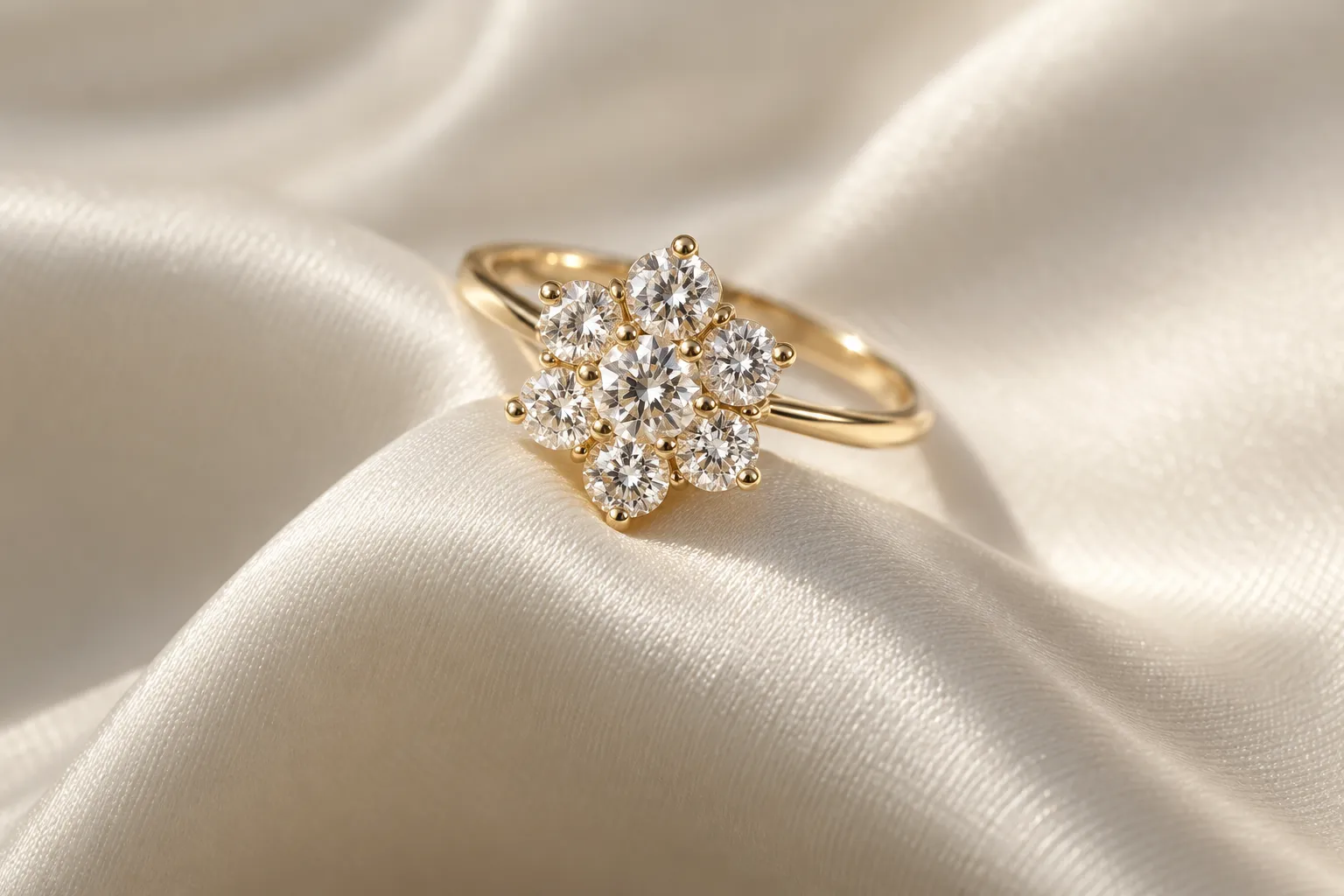
A cluster engagement ring sets several smaller diamonds so closely together that from a distance they read as one large stone: as a flower, an oval or a free, irregular group. A cluster brings plenty of surface and sparkle to the finger, without the budget a single large diamond would need.
At émin in Zurich District 4 you design your cluster ring with us, stone by stone. We show you how it looks up close, how it differs from a halo and how much care all those little prongs need.
Why a cluster ring?
Big impact, smaller budget
Small diamonds cost much less per carat than one large stone. Set together they create a surface that often looks like more on the hand than the total weight suggests.
Vintage character
Cluster rings were already popular in the 19th century and the 1920s. A flower of brilliants feels playful and a little nostalgic, without looking old-fashioned.
Free in shape
Because the ring is built from many stones, the shape is almost free: round like a flower, elongated like an oval, or deliberately irregular with mixed cuts.
Flower, oval or irregular: the shapes
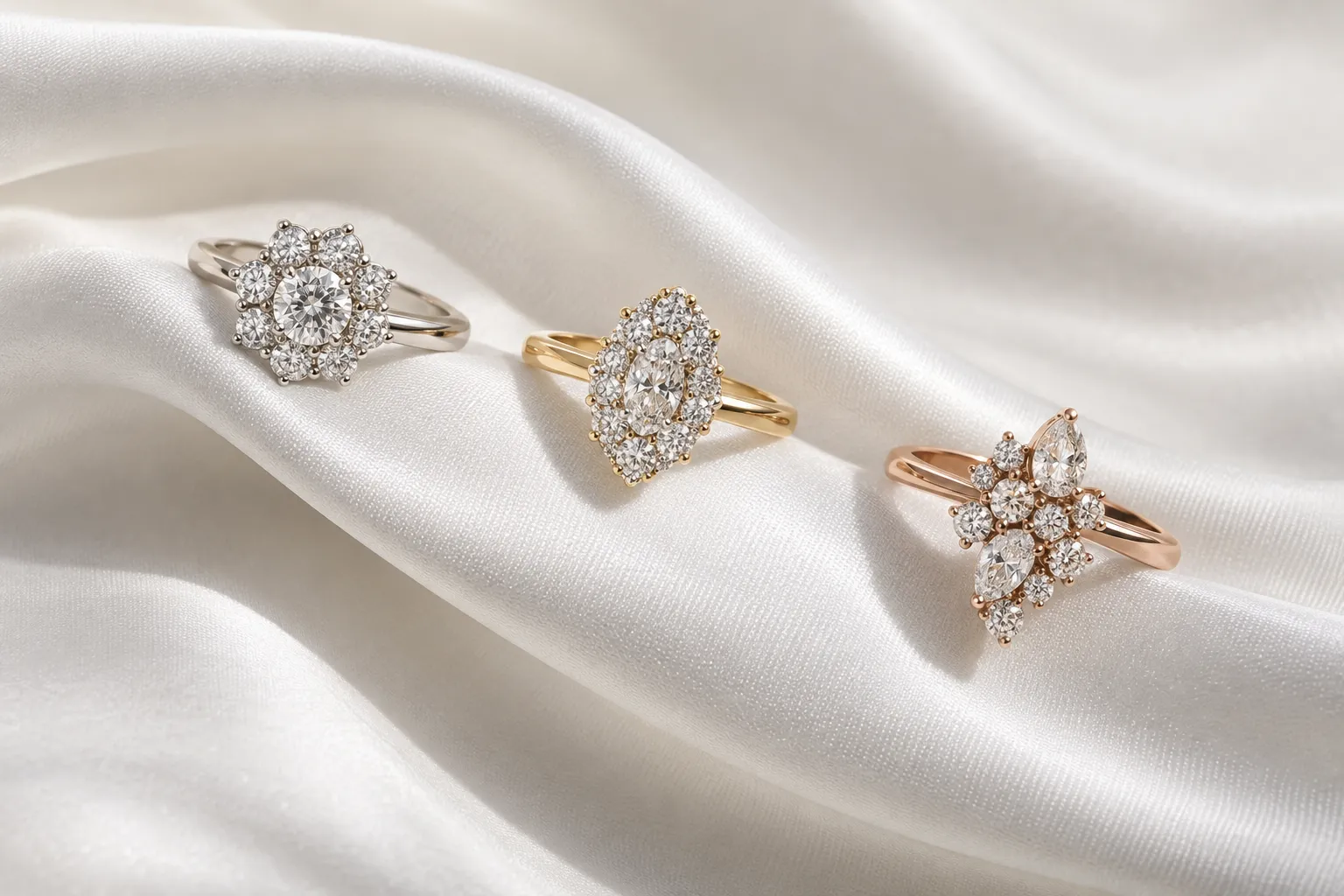
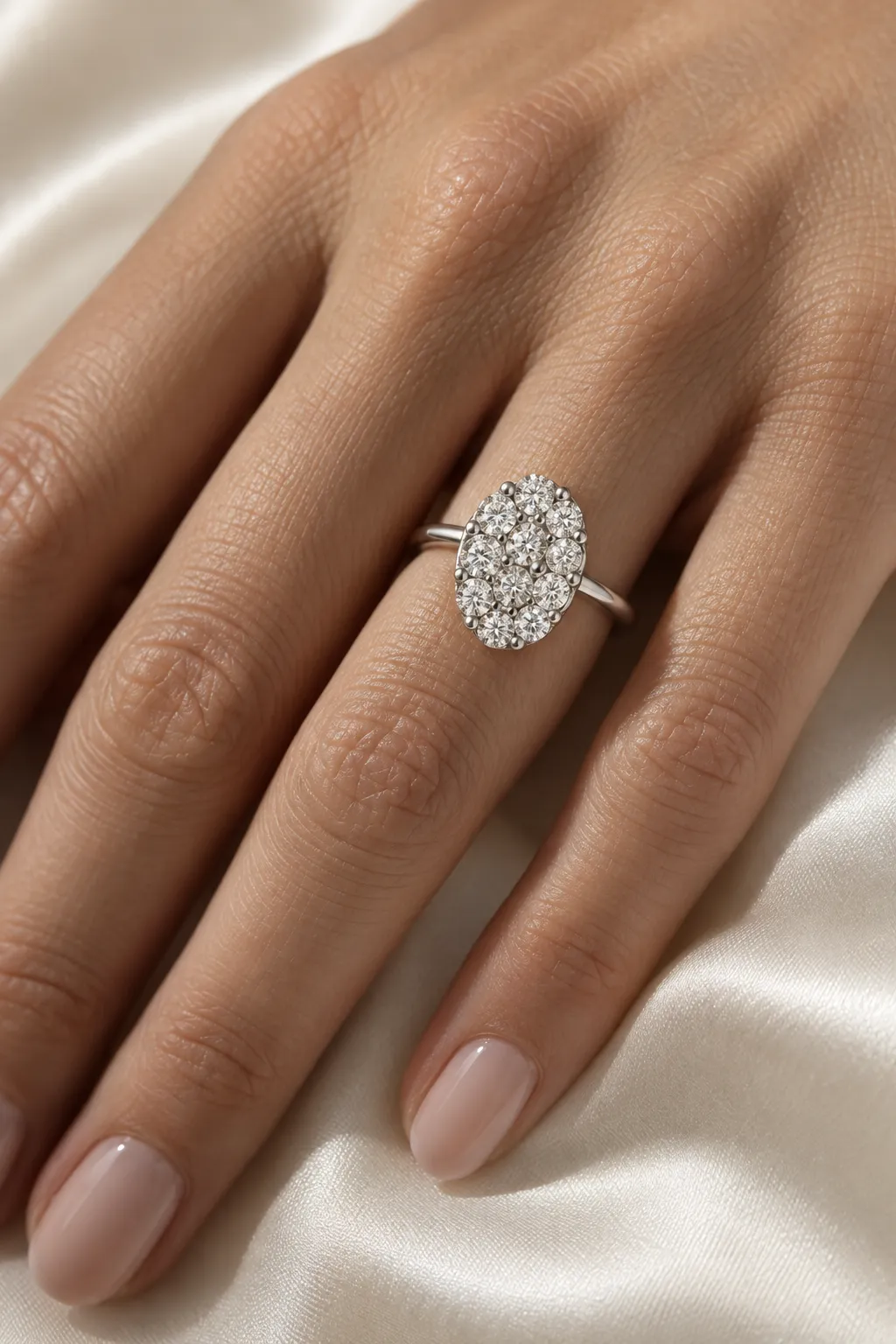
The classic is the flower: a slightly larger brilliant in the centre with six or eight equal stones around it like petals. In an oval cluster many small brilliants sit closely inside an oval outline, often with no centre stone at all, which elongates the finger much like an oval solitaire. An irregular cluster mixes brilliants with pear or marquise stones and looks casually scattered, though it's carefully planned.
Which shape suits you depends on finger length, hand size and your style. At the atelier we show you examples on the hand and sketch your version together before it's made to measure.
Cluster, halo or solitaire: the difference
Cluster and halo are often confused. The core difference: a halo centres on one large stone, while in a cluster all the stones carry the look together.
| Feature | Cluster | Halo | Solitaire |
|---|---|---|---|
| Build | Several similar stones as a group | Large centre stone with a pavé frame | One single stone |
| Look | Surface and lively sparkle, playful | Centre stone looks bigger, glamorous | Clean, calm, timeless |
| Budget | A lot of look for the money | Medium, centre stone stays the main cost | Highest for the same visual size |
| Up close | Individual stones visible | Centre stone dominates | One stone, one surface |
| Care | Many prongs, clean regularly | Pavé needs checking | Easiest |
what a cluster can and can't do
From a distance a well-set cluster looks like one large stone. Up close you see the individual diamonds and the prongs between them, and that's exactly its charm. But if you really want the single, calm flash of a solitaire, a cluster won't make you happy. We'd rather tell you that beforehand.
It matters that the stones match in colour and clarity. One yellowish stone in a white flower stands out immediately. That's why we put the stones together as a set and show them to you under the loupe before setting, lab-grown or natural.
Care: many stones, many little corners
Soap, hand cream and dust collect between the prongs of a cluster ring faster than on a solitaire, and the stones start to look dull. A bath in lukewarm water with a little washing-up liquid and a soft toothbrush is usually enough. Have the prongs checked once a year so no small stone gets lost. We're happy to do that for our clients.
What a cluster ring costs
A cluster ring is assembled from many individual stones. How many, how large and what quality decide the price, so we calculate each version individually.
Price depends on the work involved. We calculate openly, no surprises.
Before you decide you get an open breakdown: stones, metal, work.
Frequently asked questions
A cluster ring is a ring in which several smaller diamonds are set closely side by side as a group, for example as a flower, an oval or a free shape. From a distance the group looks like a larger stone, up close you see the individual diamonds. It works as an engagement ring and as a dress ring.
A halo has a large centre stone surrounded by a frame of small stones that makes it look bigger. A cluster has no dominant centre stone, or only one that's slightly larger than the others. All stones together form the picture, so a cluster is usually more affordable for a similar surface.
For the same visual size usually yes, because small diamonds cost much less per carat than one large stone. How big the difference is depends on number, quality and setting. We price both options side by side so you can compare directly.
Yes, if it's well built. A cluster can be set lower than a tall solitaire and catches less. The many prongs do need some attention: clean regularly and have them checked once a year. If you work a lot with your hands, a compact shape is the best choice.
Mostly brilliants, because they sparkle most and can be set closely together. For irregular clusters we like to combine pear or marquise stones. Lab-grown or natural: what matters is that all stones match in colour and clarity, otherwise a single stone stands out.
Yes, but it should be matched. Because a cluster is often wider than a solitaire, a straight band sometimes needs a little distance, or we shape it with a slight curve so it sits flush. Ideally we plan both rings together, or you bring the cluster to your wedding ring appointment.
Quick enquiry
Your cluster ring, stone by stone
Send us an inspiration or briefly describe the shape you like. We advise you on stones, setting and price, in Zurich or by video.