Diamond shapes compared
All diamond shapes compared: from round to heart
Round, oval, cushion or pear: the diamond shape shapes how an engagement ring reads far more than most people expect. On this page we compare all 13 common diamond shapes, with honest notes on sparkle, size effect, price level and visible inclusions, no jargon attached.
Eight shapes have their own detailed page at émin, because they're the ones people ask about most. Five rarer cuts we cover here in short. By the end you'll know which shape fits your idea, your budget and your finger, and can either read on or send us a message directly.
What the shape actually changes
Sparkle
Round and other brilliant cuts have more facets and sparkle harder in the light. Step cuts like emerald or baguette read calmer, almost mirror-like, and show inclusions more clearly.
Size effect
Elongated shapes like oval, pear or marquise look larger for the same weight than round or square cuts, simply because they cover more surface area on top of the finger.
Price per carat
Cutting a round brilliant wastes the most rough diamond, which is why it usually costs the most per carat. Fancy cuts like radiant or cushion use the rough stone more efficiently and are often cheaper.
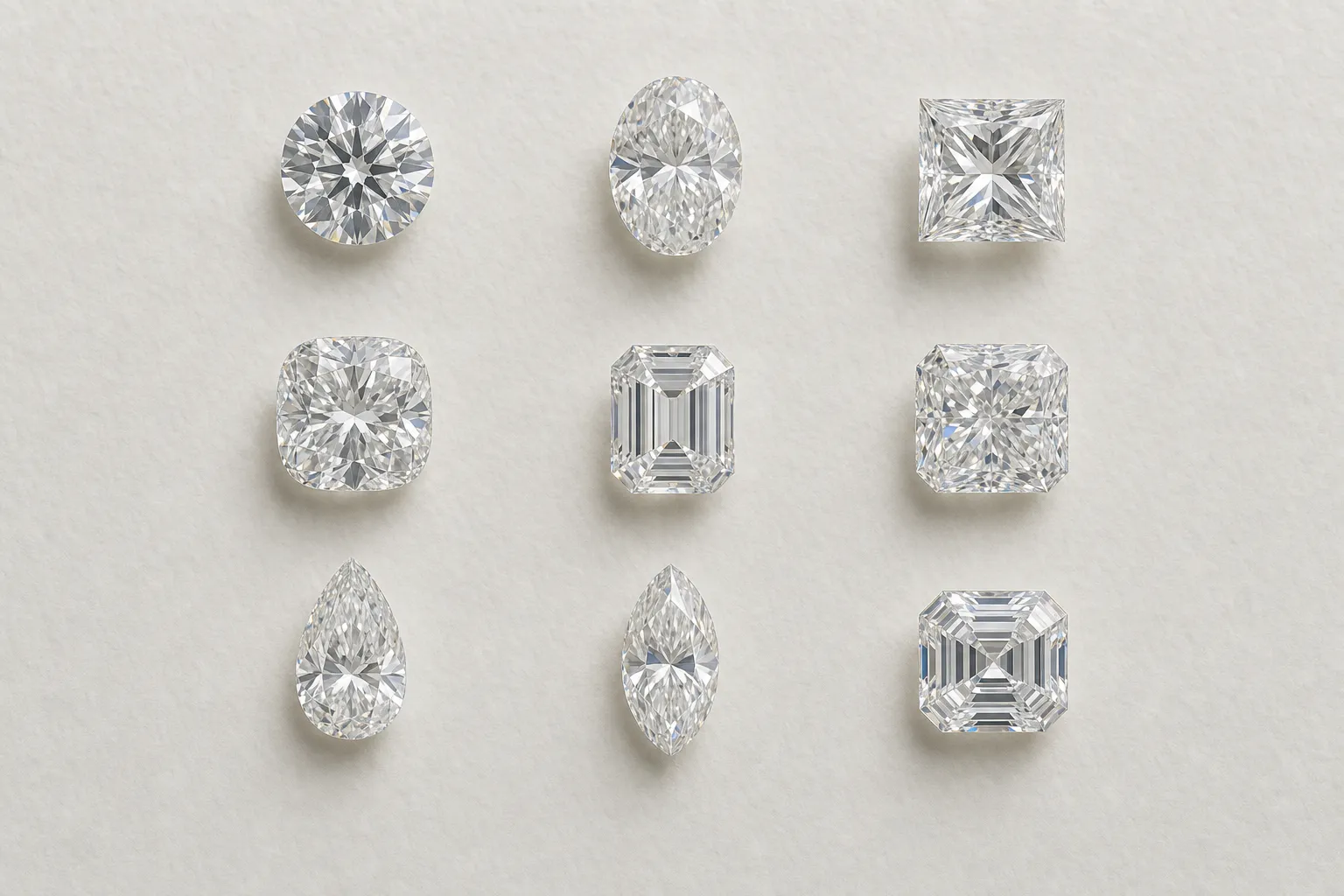
The eight most requested shapes
Every shape has its own page with models, prices and FAQ.
Six more shapes, without their own page
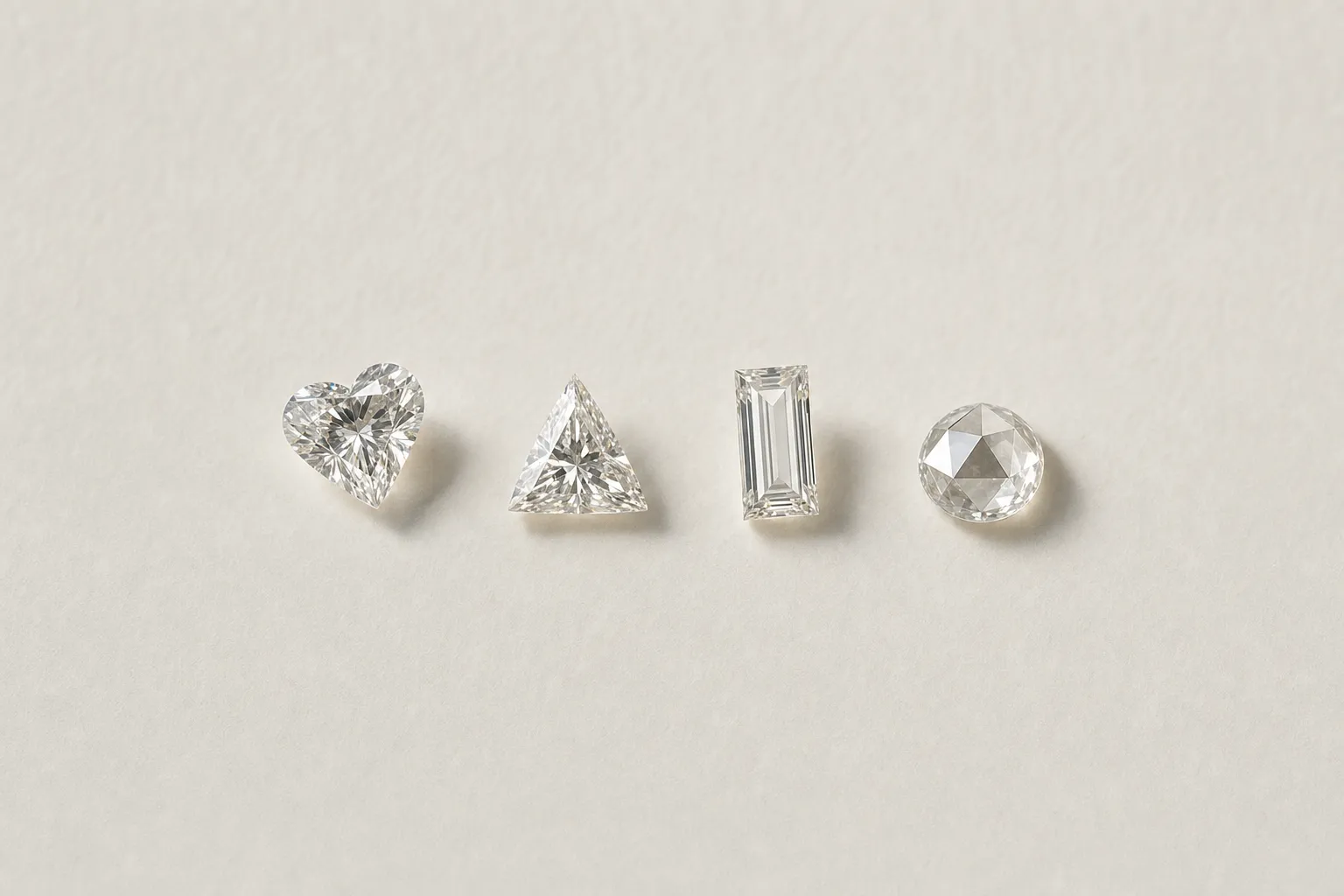
Some cuts come up less often in conversation, but still deserve a short explanation. Asscher is a square step cut with cropped corners, like a compact emerald cut, very clear and geometric. Heart obviously stands for love, but is technically demanding: the symmetry of the two lobes and the point need to be exact, or the shape reads lopsided.
Baguette is a narrow, rectangular step cut we mostly use as a side stone next to a larger centre stone, rarely as the main stone on its own. Trillion is triangular with straight or slightly curved edges and sparkles boldly, a bold cut for anyone who wants something unusual.
Rose cut has a flat back and a faceted dome, a historic cut with a soft, warm glow rather than hard fire, popular on vintage-style rings. Old European cut is the forerunner of the modern round brilliant, with a smaller table, larger culet and a softer, candlelit kind of sparkle you often see in antique rings. Not sure which shape suits you? Our guide can help you decide.
All 13 shapes compared
A first orientation. We'll discuss which shape is right for you in person.
| Shape | Sparkle | Size effect | Price level | Inclusions visible |
|---|---|---|---|---|
| Round | very strong | average | highest per carat | barely visible |
| Oval | strong | larger than round | high | slightly visible at the points |
| Princess | strong | reads more compact | medium to high | visible in the corners |
| Cushion | medium to strong | larger than round | medium | barely visible |
| Emerald | calm, mirror-like | reads long and slender | medium | clearly visible |
| Radiant | strong | reads large | medium | slightly visible |
| Pear | strong | reads the longest | medium | visible at the point |
| Marquise | strong | largest per carat | medium | visible at the points |
| Asscher | calm, mirror-like | reads compact | medium | clearly visible |
| Heart | medium | reads mid-sized | medium to high | visible in the cleft |
| Baguette | calm | reads narrow and long | on the lower side | clearly visible |
| Trillion | very strong | reads wide | on the lower side | slightly visible |
| Rose cut | soft, warm | reads flat and wide | varies | partly visible |
Guide values only, depending on size, quality and setting. We cover Old European cut separately above, since it's rarely used as a direct benchmark.
What a ring with your chosen shape costs
Guide prices so you can get your bearings in advance. We always discuss the exact price in person.
Price depends on the work involved. We calculate openly, no surprises.
Guide prices, as of 2026, incl. VAT. The exact price depends on stone, metal and work.
Frequently asked questions
The round brilliant sparkles the most, because its geometry is the most researched and optimised for fire. Marquise and trillion also sparkle strongly thanks to their many small facets. Step cuts like emerald or baguette read calmer instead, reflecting broad flashes of light rather than tiny bursts.
Elongated shapes like oval, marquise or pear look the largest per carat, because they cover more surface area on top of the finger than compact shapes like round or princess. If you want to visually maximise stone for your budget, an elongated shape is usually the better choice without paying more in weight.
Per carat, baguette, rose cut and often trillion tend to be more affordable, because cutting them wastes less rough diamond than a round brilliant. Cheaper doesn't mean lower quality, only a different shape: you're paying less for the cut, not for the stone's grade. Colour, clarity and carat weight still set the price on top.
Step cuts like emerald, asscher or baguette have large, open facets that work like a window into the stone. Small inclusions stand out more there than in a brilliant, whose many small facets bend light more and hide irregularities better. For these shapes we usually recommend a slightly higher clarity grade.
Our collection shows each model with one particular shape, so you get a real sense of how it looks. Many settings can still be adapted to a different shape, which we discuss in the consultation. For a fully custom design, we build the setting around your chosen stone from the start anyway.
Elongated shapes like oval, marquise or pear visually lengthen the finger, so they tend to look especially elegant on narrow hands. Round or square shapes like princess or cushion look more compact and suit most hand shapes without emphasising any particular effect. In the end, though, the shape you love matters most.
A brilliant cut like round or princess has many small triangular or kite-shaped facets that scatter light in every direction for strong sparkle. A step cut like emerald or baguette has fewer, larger, parallel facets that act more like mirrors: calmer to look at, but showing the stone's clarity and colour far more clearly.
Quick enquiry
Which shape suits you?
Tell us which shape you like. We'll advise you on size, price and setting, with no sales pressure.