
2026-09-03 · 5 min.
585 or 750: which gold suits your jewellery?
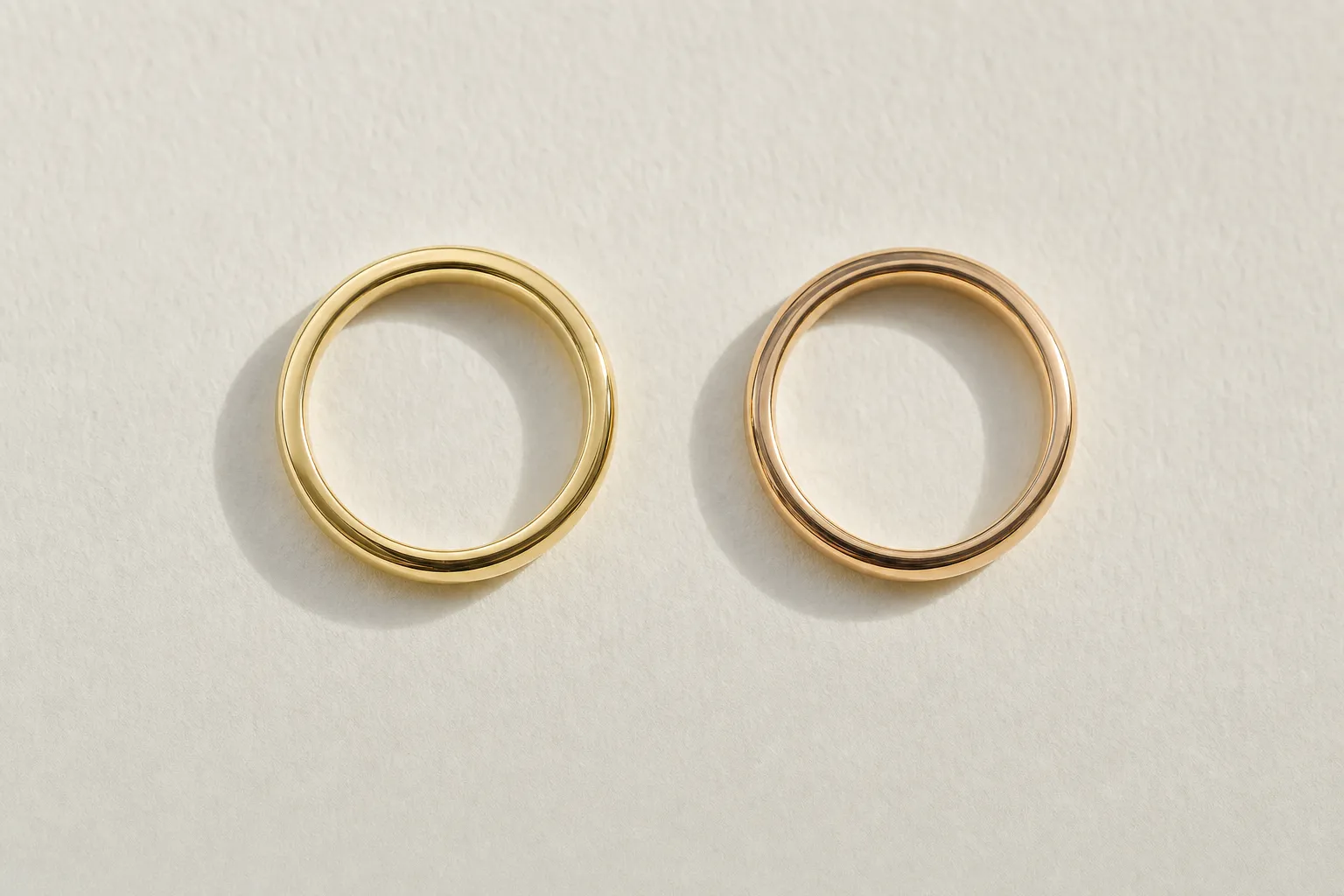
585 and 750 are the two most common gold alloys for jewellery in Switzerland, the number stands for fineness: 585 means 58.5 percent pure gold, equivalent to 14 karat, 750 means 75 percent pure gold, so 18 karat. The rest in each case is a mix of other metals such as copper, silver or palladium. Here's what those few percentage points of difference actually mean for hardness, colour, allergy risk and the price of your jewellery.
What the numbers 585 and 750 actually mean
Fineness states how many of 1,000 weight parts of a piece of jewellery are pure gold. 585 stands for 585 of 1,000 parts, or 58.5 percent, the American and British system calls the same thing 14 karat. 750 stands for 750 of 1,000 parts, 75 percent, 18 karat in the karat system. Pure gold, 999 or 24 karat, is practically too soft for jewellery and is therefore almost never worked on its own, but always alloyed with other metals that largely determine stability and colour.
Hardness: why 585 gold often feels sturdier
Because 585 gold has a higher share of other metals than 750, it's generally somewhat harder and more scratch-resistant in daily wear, provided the alloy is well chosen. That makes 585 a popular choice for pieces that get worn a lot and take heavy use, such as everyday rings or men's jewellery. 750 gold has a lower share of other metals, so it's correspondingly softer, but has a richer fineness. The difference is real but not dramatic, both alloys, if well made, last a lifetime as long as you don't deliberately expose them to rough treatment.
Colour: the same gold tone, different intensity
Because 750 gold contains more pure gold, yellow gold in 750 tends to look richer and warmer in tone than the same alloy in 585, where the higher share of other metals makes the tone slightly lighter and cooler. With white and rose gold, the difference is often less noticeable, because colour there depends more on the specific alloy chosen, such as its copper or palladium content, than on fineness alone. In the end, your personal taste decides, both finenesses come in yellow, white and rose gold.
Allergy: what to watch for
As the share of other metals rises, so in principle does the risk that sensitive skin reacts to a metal in the alloy, usually nickel is the trigger, other additives less often. 585 gold theoretically carries a slightly higher irritation potential than 750 because of its higher share of other metals, but in practice what matters most is whether nickel is present in the alloy at all, not fineness alone. In Switzerland and the EU, nickel-containing alloys for jewellery are strictly regulated, and if you have known sensitivity, we specifically ask about the exact alloy so you get a piece you can genuinely wear without issues.
- 585 (14 karat): 58.5% gold, tends to be harder, often cheaper, popular for everyday pieces.
- 750 (18 karat): 75% gold, richer fineness, deeper colour tone, usually somewhat more expensive.
- Hardness also depends on the specific alloy chosen, not on fineness alone.
- Allergy risk drops mainly through a nickel-free alloy, less through fineness alone.
Which gold for which piece
Whether 585 or 750 is the better choice for you depends less on fineness alone than on how and how often you wear the piece, and whether hardness or colour depth matters more to you. For a detailed overview of which metal generally suits your daily life and style best, gold, white gold, platinum or another option, see our article on which metal suits you.
Price: a matter of relation
Because 750 gold contains more pure gold than 585, a piece in 750 costs noticeably more at the same size and workmanship than the same piece in 585, and the difference grows with the piece's weight. For a delicate little chain it barely registers, for a solid ring or a wide gold chain the difference can become clearly noticeable. For yellow gold engagement rings, where this question comes up especially often, see an overview on our yellow gold engagement ring page, and for men looking for a gold chain in a matching alloy, our men's gold chain page.
In the end, neither 585 nor 750 is fundamentally the better choice, it's the alloy that fits your piece, your daily life and your budget. We'll advise you honestly on this at our atelier in Zurich district 4 or by video, with real samples of both finenesses to compare, so you can see and feel the difference yourself.

Founder of émin, jeweller in Zurich
Have questions about your ring? Talk to us directly.
Book an AppointmentRelated pages
Quick enquiry
Let's talk about your ring.
A free, no-obligation consultation at the atelier in Zurich or by video. Honest answers, no sales show.