
2026-09-03 · 5 min.
D to Z: diamond colour grades explained simply
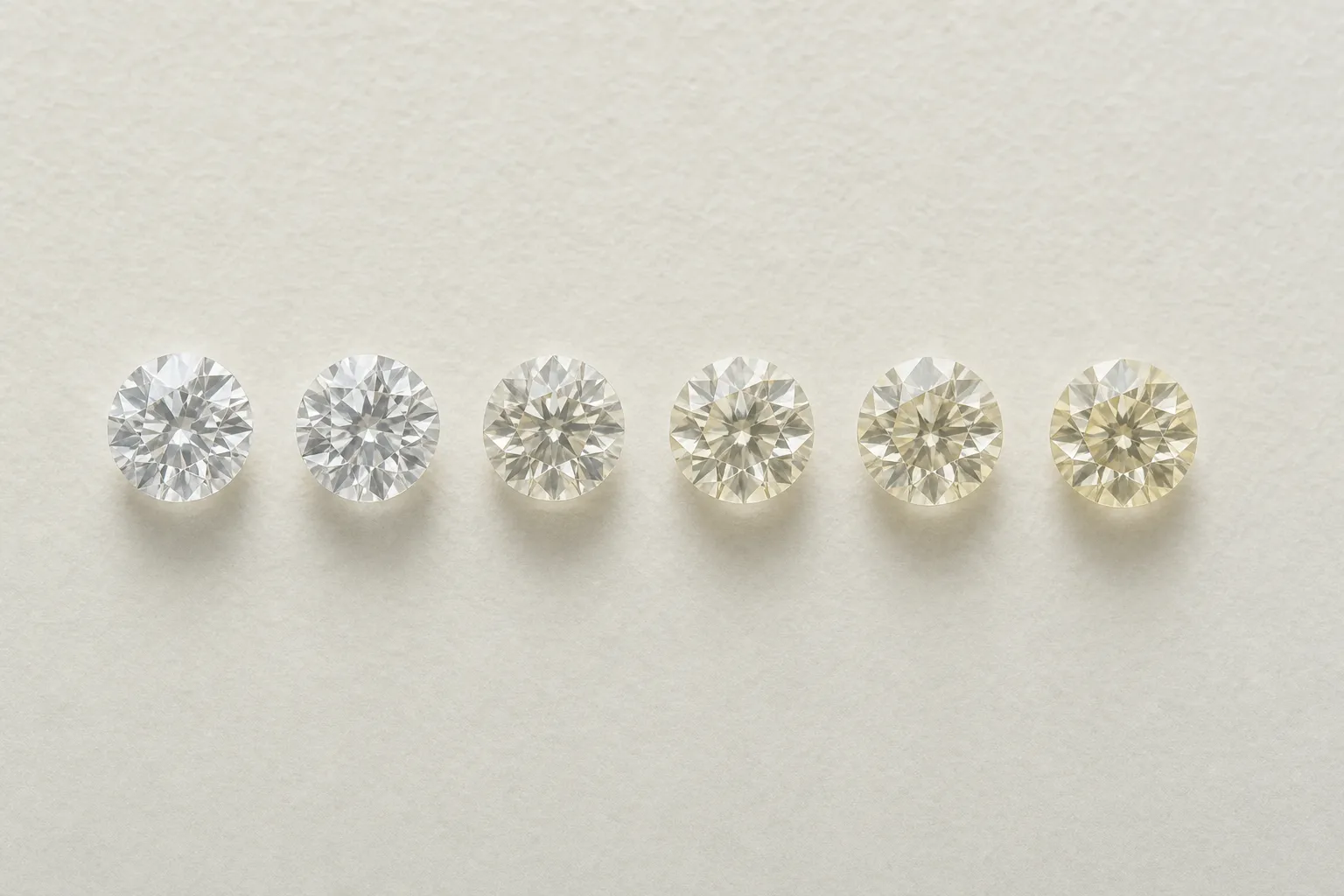
A diamond's colour scale runs from D, completely colourless, to Z, noticeably tinted yellow. For engagement rings, the first three groups matter most: D to F count as colourless, G to J as near colourless, K to M as faintly tinted. Here is which group actually matters for your ring, and why the setting plays a role too.
Why the scale starts at D, not A
Before today's scale existed, different dealers used their own systems, some with letters starting at A, some with stars or numbers, all different and hard to compare. When GIA introduced the D to Z scale in the 1950s, it deliberately started at D so nobody would confuse it with the old, often inflated A or AAA labels. That created a measure that applies the same way worldwide, whether the stone is sold in Zurich, New York or Antwerp.
The three groups that matter for rings
- D to F, colourless: the whitest a diamond gets, no detectable yellow tint, hard to tell apart even side by side.
- G to J, near colourless: a minimal yellow tint, usually only noticeable next to a D stone, appears pure white to most eyes once set.
- K to M, faintly tinted: a light, warm yellow tint that becomes visible to the naked eye, especially in larger stones.
From N onward the yellow tone becomes progressively clearer, until around S to Z it is perceived as its own, often deliberately chosen colour, where the transition to what is traded as fancy colours already begins.
How professionals actually determine colour
At home under a bedside lamp or in a display case with warm lighting, you can barely judge a diamond's colour reliably, because the light itself already adds its own tint. Gemologists therefore grade colour under standardised, neutral daylight-equivalent light, usually with a special lamp, laying the stone table-down on white paper so no reflection from the setting or the surroundings distorts the result. It is compared against a set of so-called master stones with already-known colour, one by one, until the matching grade is found. That is exactly what makes the scale so reliable: it does not depend on the light in a shop or on anyone's mood that day, but on a fixed, repeatable procedure. Two professionals grading the same stone independently will therefore almost always reach the same result, even on different days in different places. For you as a buyer, the takeaway is the opposite of what a showroom wants you to believe: never trust your eye alone under warm shop lighting, which flatters practically every stone, trust what is graded neutrally on the certificate instead.
Why the setting metal plays a role too
What many people don't know is that a diamond's colour never stands alone, it always plays off the metal around it. In white gold or platinum the stone sits against a very light, cool frame, so a slight yellow tint stands out more. In yellow or rose gold, on the other hand, the warm metal colour reflects into the stone, and a K or even an L can look almost as white there as a G would in white gold. We explain how to pick the right metal for your style in detail in our article on yellow, white and rose gold.
Where you can save money without anyone seeing it
For a white gold or platinum setting, a colour between G and J is usually the sweet spot, giving you a clean white without paying for a difference to D that nobody sees. For yellow or rose gold, you can comfortably go a step warmer, often K, since the metal visually balances the tint and you save noticeably. We explain how colour interacts with cut, clarity and carat in our general 4C article, and for diamond engagement rings specifically you will find example stones on our diamond engagement ring page.
In the end, what matters is not the letter on the certificate, but how the stone looks on your finger and in your setting. Bring your preferred metal to our atelier in Zurich or to a video call, and we will lay several colour grades side by side and show you exactly where the difference stops mattering to you.
Founder of émin, jeweller in Zurich
Have questions about your ring? Talk to us directly.
Book an AppointmentQuick enquiry
Let's talk about your ring.
A free, no-obligation consultation at the atelier in Zurich or by video. Honest answers, no sales show.