
2026-09-03 · 5 min.
How lab-grown diamonds are made: CVD and HPHT
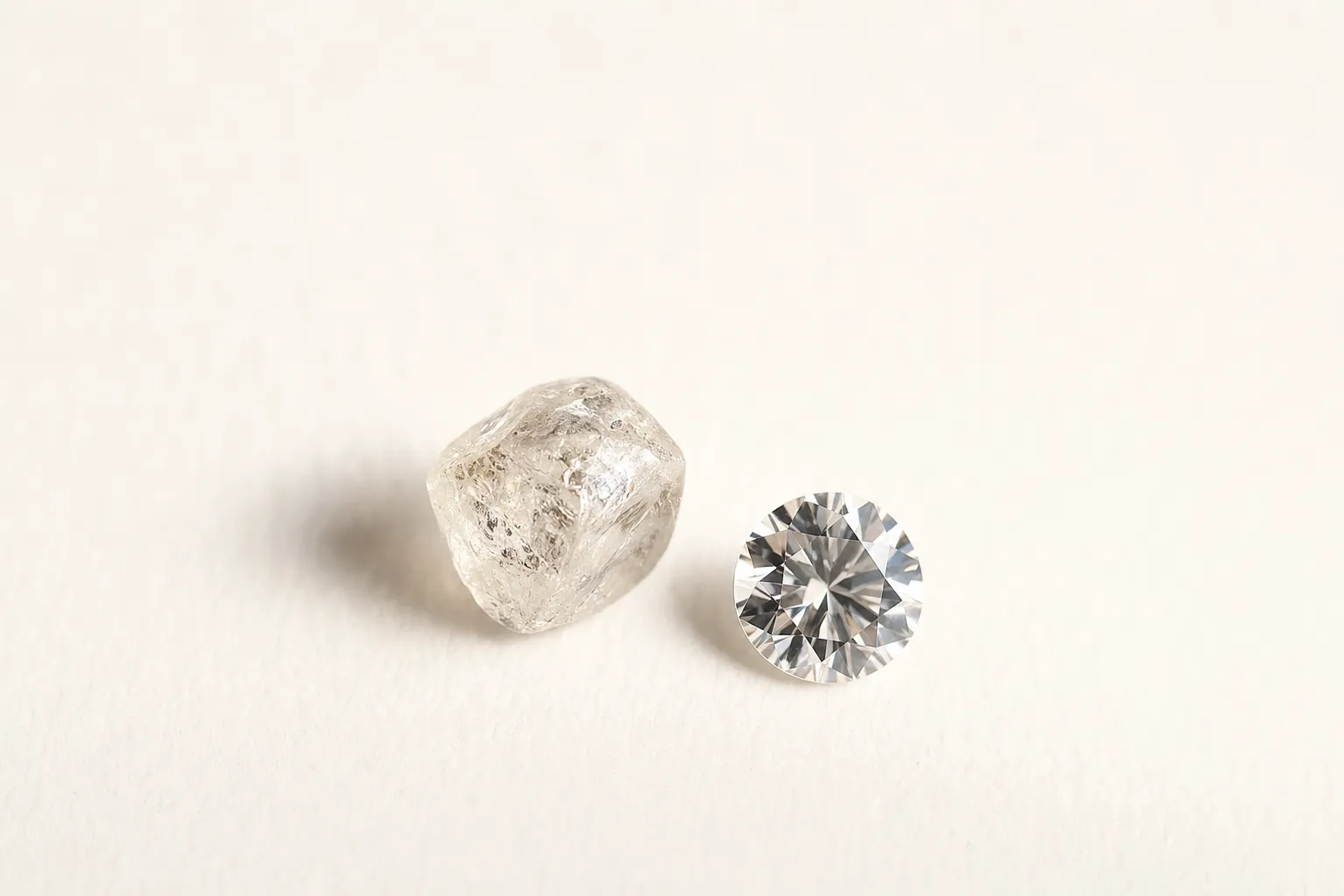
A lab-grown diamond forms when carbon atoms arrange themselves into a diamond crystal under controlled conditions, either through intense pressure and heat (HPHT) or from a hot carbon gas (CVD). Both methods take weeks to a few months and produce a stone that is chemically, physically and optically identical to one formed underground. Here is how each process actually works, what sets them apart, and why it barely matters for your buying decision.
HPHT: the process nature also uses
HPHT stands for High Pressure High Temperature. The method recreates, in a machine and within weeks, what happens deep inside the earth over millions of years. A tiny diamond seed crystal is placed together with pure carbon, usually graphite, inside a press and heated to around 1,400 to 1,600 degrees Celsius while being subjected to a pressure of roughly 5 to 6 gigapascals, similar to the pressure found about 150 kilometres below the surface. Under these conditions, carbon atoms bond to the seed layer by layer until a rough diamond has formed. HPHT was the first method that made artificial diamonds possible, back in the 1950s, though at the time only for industrial use, not gem quality.
CVD: growth from a gas
CVD stands for Chemical Vapour Deposition. Here too the process starts with a thin diamond slice as a seed, placed inside a vacuum chamber. The chamber is filled with a carbon-rich gas, usually methane mixed with hydrogen. Microwaves or a strong electric field split the gas into plasma, a hot, electrically charged cloud. Individual carbon atoms break free from the gas and settle onto the seed, atom by atom, layer by layer. After a few weeks, a rough diamond has grown. CVD works at far lower pressure than HPHT, but needs very precise control of temperature and gas composition so the stone grows cleanly and without internal stress. Most of the larger lab-grown diamonds used in rings today come from CVD, while HPHT is often used afterwards to improve the colour of a finished stone, including ones originally grown by CVD.
What matters at the end is the stone, not how it grew
For you as a buyer, it makes no visible or practical difference whether a stone grew through CVD or HPHT. Both result in a diamond with the same hardness, the same brilliance and the same chemical composition as one formed naturally, indistinguishable to the naked eye and even under an ordinary loupe. Only specialised laboratory equipment can detect the fine growth patterns that reveal which method was used, and that is exactly what gets noted on the certificate.
- HPHT: high pressure and heat, mirrors the natural process, historically the older method.
- CVD: growth from hot carbon gas in a vacuum chamber, today the most common method for larger stones.
- Both methods take weeks to a few months, not millions of years.
- Either way, the result is a real diamond, chemically and optically identical to a natural one.
- The certificate, IGI or GIA, states which method produced the stone.
Why this mostly matters for the price
The real difference between a lab-grown diamond and a natural one is not the look, it is the price: because lab-grown diamonds form in weeks rather than millions of years, and mining is not part of the process, a lab-grown stone of the same size and quality costs a fraction of a natural one. We explain what that means for your engagement ring in detail in our comparison of lab-grown and natural diamonds. For a full overview of lab-grown diamonds, from origin to certification, visit our lab-grown diamonds page.
CVD or HPHT, what matters to us is the stone that fits you, with a certificate that states its origin honestly. If you are considering an engagement ring with a lab-grown diamond, we are happy to show you stones from both methods side by side, at our atelier in Zurich or by video, so you can see the difference, or the lack of one, for yourself. You can also read more on our engagement ring with lab-grown diamond page.
Founder of émin, jeweller in Zurich
Have questions about your ring? Talk to us directly.
Book an AppointmentQuick enquiry
Let's talk about your ring.
A free, no-obligation consultation at the atelier in Zurich or by video. Honest answers, no sales show.