
2026-09-03 · 5 min.
Nişan and Söz: rings for a Turkish engagement
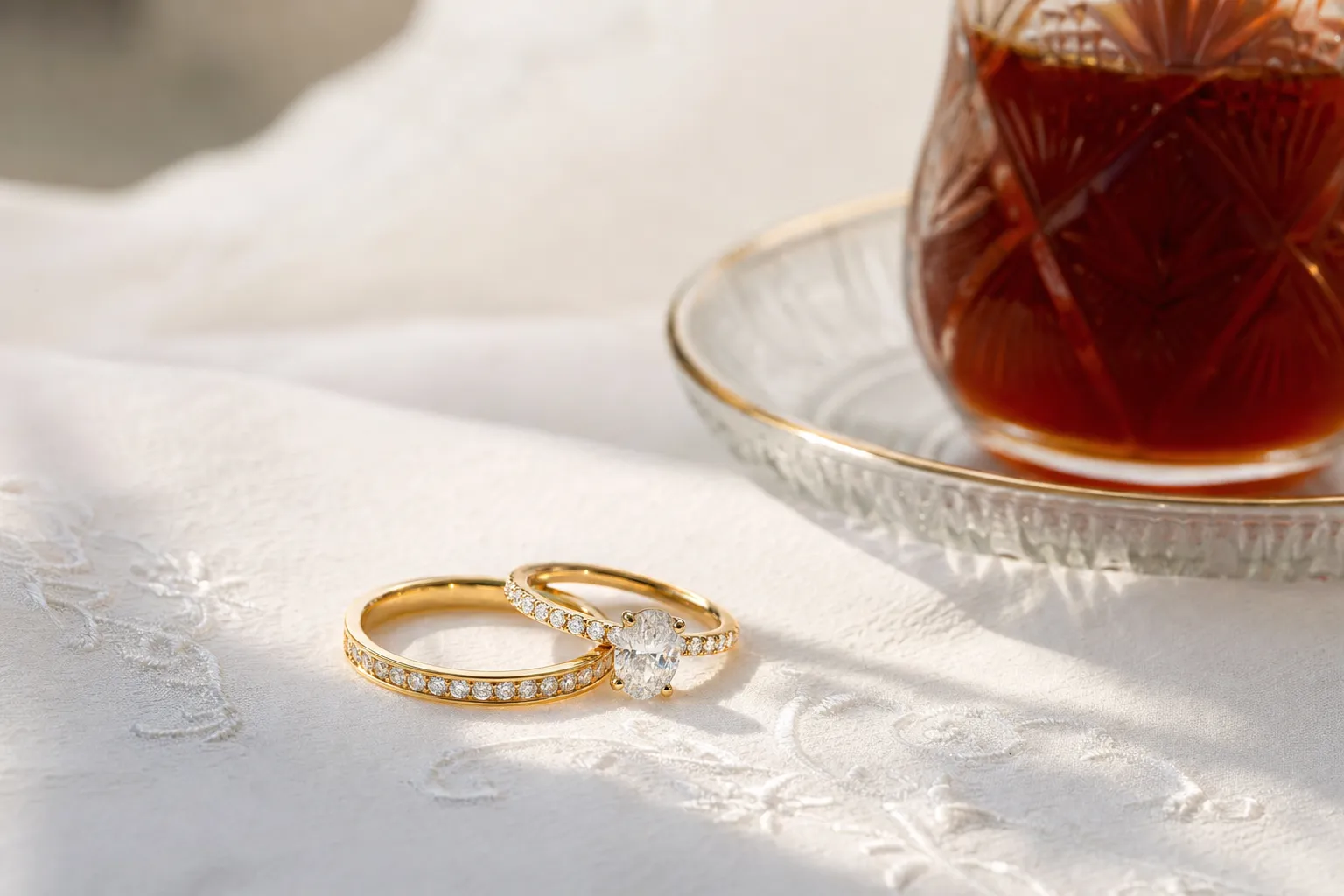
Anyone getting engaged into a Turkish family in Switzerland, or with Turkish roots themselves, quickly comes across two terms with no direct German or English equivalent: Söz and Nişan. Both mark steps on the way to marriage, both carry their own customs around rings, and both are lived very differently across the families we advise in the atelier. Here is the broad outline, with the caveat that details vary from family to family and region to region.
Söz: the given word
Söz literally means "the word" or "the promise". It is a smaller, often more informal step before the actual engagement, where both families gather in a close circle and give their mutual consent to the match. Not every family treats Söz as its own occasion, some go straight to Nişan, in others Söz is the moment when a shared future is first spoken about officially. A ring is often already given at Söz, usually simpler than the one at Nişan, sometimes purely symbolic, such as a plain gold band.
Nişan: the big engagement celebration
Nişan is the actual, usually larger engagement celebration, with both families, often friends too, sometimes hundreds of guests. At its centre is a ritual most people recognise instantly: a red ribbon is threaded through the couple's rings and placed on their ring fingers, usually by the oldest family member present. Someone then cuts the ribbon with scissors, often an unmarried relative or a childless person for symbolic reasons. Cutting the ribbon marks the official start of the engagement, and the red ribbon itself stands for luck and protection.
- Before the ritual: the rings sit ready, often on a cushion or tray, joined by the red ribbon.
- During the ritual: an elder family member places the ring on each partner, usually on the right hand first.
- After the cut: congratulations, often applause, then the actual celebration begins with food and music.
- After Nişan: the rings are worn day to day, often right up until the wedding itself.
Why we deliberately stay general here
Turkey is a large country with many regions, religious communities and both urban and rural traditions, and the same is true for Turkish-rooted families in Switzerland. A Nişan in Istanbul can look different from one in Anatolia, a secular family celebrates differently than a religious one, and the second or third generation in Switzerland often blends in their own, new elements. We deliberately describe here the common outline we see most often in the atelier, without claiming there is one correct way to celebrate Nişan. Feel free to tell us at an appointment how it's done in your family, it helps us suggest the right ring.
Which hand, and what happens after the wedding
In Turkey it is common to wear the engagement ring on the right hand, unlike German-speaking Switzerland, where the left hand is the majority habit. At the wedding, many couples then move the ring to the left hand, alongside the wedding band, others simply leave it on the right. There is no single correct version here, it depends on family, region and personal taste, and we recommend discussing it openly with your partner and family rather than assuming. We also explain how differently the hand custom is lived within Switzerland itself in our article on the ring hand.
Which ring suits a Nişan
A solitaire ring, a single stone in a clean setting, is often popular for Nişan because it is clearly visible during the ceremony and looks understated and elegant in photos. A yellow gold ring is equally common, especially in more traditionally minded families, while younger couples increasingly choose white gold or their own designs. What matters most is that both rings match in colour and style, since they are shown side by side during the ritual. We are happy to advise on stone, setting and metal, without assuming what a ring "should" look like for a Turkish couple, every couple decides that for themselves.
What émin does not offer, and what we do instead
Alongside the engagement rings themselves, bridal gold is part of the celebration for many Turkish families, usually gifted by guests as bracelets or coins in 22 carat gold. We do not carry this classic bridal gold at émin, because it is its own craft with its own alloys, and we do not want to offer it alongside our work without doing it justice. What we specialise in are engagement and wedding rings in 18 carat (750) gold, with natural or lab-grown diamonds, individually designed and honestly priced. Engagement rings with us start at CHF 1,900, and for Nişan a joint appointment is worthwhile, at our atelier in Zurich district 4 or by video, where we advise in German, English and Turkish. More on our advice for Turkish-speaking couples is on our page for Turkish families in Zurich, and a first overview of the classic solitaire style is on our solitaire ring page.
Founder of émin, jeweller in Zurich
Have questions about your ring? Talk to us directly.
Book an AppointmentRelated pages
Quick enquiry
Let's talk about your ring.
A free, no-obligation consultation at the atelier in Zurich or by video. Honest answers, no sales show.