
2026-09-03 · 5 min.
VVS, VS, SI: what diamond clarity grades mean
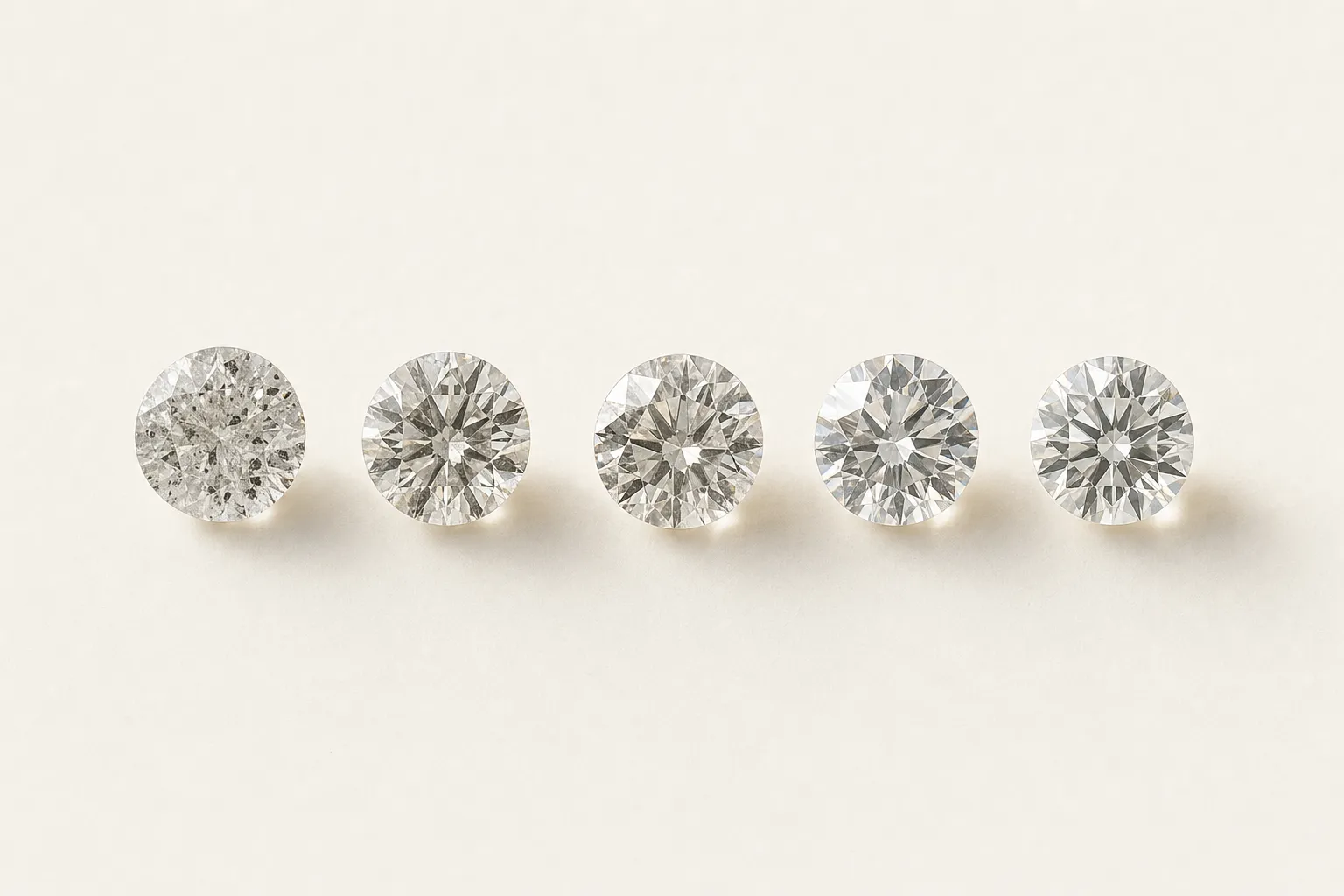
Clarity describes how many tiny inclusions a diamond has, graded from FL, flawless, down to I3, clearly included. VVS, VS and SI are the three middle grades on that scale, and they are exactly the ones that make the real difference on most engagement rings, not the two extremes. Here is what the abbreviations actually mean and which grade genuinely fits your ring.
The full scale at a glance
- FL, Flawless: no inclusions visible, not even under ten times magnification.
- IF, Internally Flawless: no internal inclusions, only tiny surface features.
- VVS1 and VVS2, Very Very Slightly Included: extremely small inclusions, hard to find even for a professional under strong magnification.
- VS1 and VS2, Very Slightly Included: small inclusions, visible under ten times magnification, virtually never with the naked eye.
- SI1 and SI2, Slightly Included: inclusions clearly visible under a loupe, with SI2 sometimes visible to the naked eye depending on cut and size.
- I1 to I3, Included: inclusions clearly visible even without a loupe, at I2 and I3 they can even affect the stone's durability.
What these inclusions actually are
Inclusions are tiny crystals, fine fractures or cloudy patches that got trapped while the diamond formed, deep underground over millions of years or in a lab over weeks. They are something like a stone's fingerprint, not a manufacturing flaw and not a sign of poor quality. Almost every diamond has them, completely inclusion-free stones (FL, IF) are rare and priced accordingly, without you ever seeing the difference on your finger.
Why the size of an inclusion is not the whole story
A certificate assigns one grade to the stone as a whole, but two stones with the same clarity grade can look completely different on the finger. What matters is not only how big an inclusion is, but also where it sits and how many there are. A single small inclusion near the edge, hidden under the setting, is practically never noticed. The same inclusion sitting centrally under the top facet, the table, can stand out more even at a good clarity grade, because that is exactly where most light enters and exits. Colour and type of inclusion matter too: a dark spot stands out more than a light one, a single larger inclusion more than several tiny, scattered ones. That is why it is worth looking at the so-called plot on the certificate, a small diagram showing exactly where the inclusions sit, rather than reading only the letter grade.
Where quality genuinely pays off
The honest truth: from VS1 downward, often even from SI1, most diamonds are clean to the naked eye, so-called eye clean. The jump from FL to VVS costs noticeably more without anyone, not even you after years of wearing the ring, ever spotting a difference. Two things shift that line: the size of the stone, a larger diamond shows inclusions more readily than a small one, and its shape. Round brilliant cuts hide inclusions best through their facet pattern, while step cuts like emerald or baguette show them more clearly because their large, flat facets act like a window. We explain how the four C interact in more depth in our basics article on the 4C.
Why 'VVS' is often just a sales word in iced-out jewellery
Especially with chains, bracelets and pendants set with many small stones, 'VVS' is often used as a pure marketing term, without an actual certificate behind it. A genuine clarity grade always applies to one graded, certified stone, not to an entire piece with hundreds of tiny loose diamonds. What a credible claim looks like on iced-out pieces, and what to watch for, is explained on our iced-out jewellery page.
On an engagement ring with one large, visible centre stone, on the other hand, clarity genuinely matters, especially when you are weighing different carat sizes. We break down how carat, clarity and price fit together, stone by stone, on our diamond engagement ring page. Bring us your budget and we will show you several clarity grades side by side at our atelier in Zurich, so you can see for yourself where the difference stops being visible to you.
Founder of émin, jeweller in Zurich
Have questions about your ring? Talk to us directly.
Book an AppointmentQuick enquiry
Let's talk about your ring.
A free, no-obligation consultation at the atelier in Zurich or by video. Honest answers, no sales show.