
2026-09-03 · 5 min.
What is a tennis chain, and why is it called that?
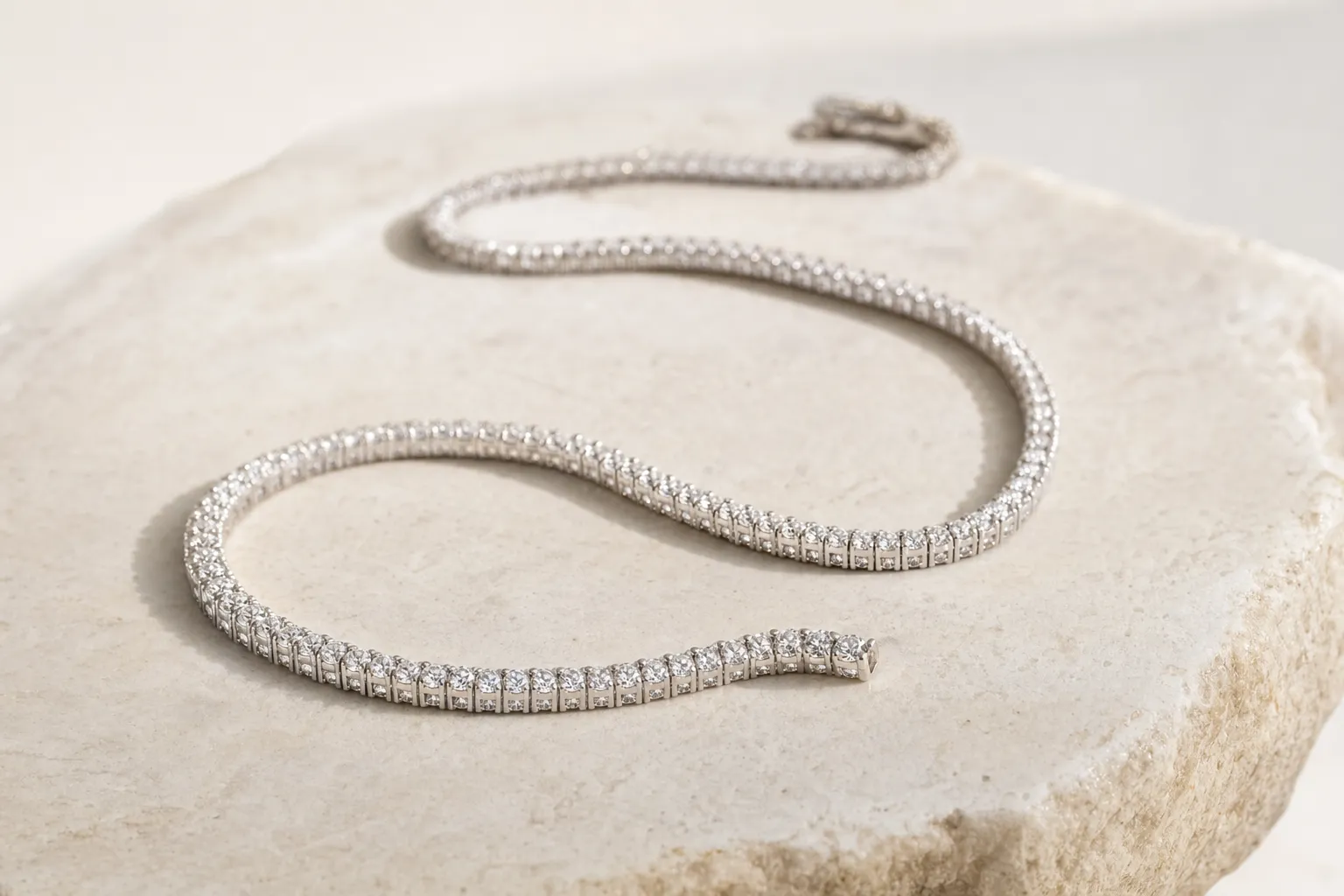
A tennis chain is a necklace where equally sized stones, usually diamonds, sit right next to each other in an unbroken line, each set individually but together reading as one continuous strip of sparkle. The name has nothing to do with rallies or serves, it comes from a specific moment on a tennis court, which we tell you here, along with what actually defines a tennis chain today.
Where the name really comes from
The story starts in 1987 at the US Open in New York. Tennis player Chris Evert was wearing a diamond bracelet during a match when it came loose and fell onto the court. She stopped play and asked to resume only once the bracelet had been found. The moment made headlines around the world, and ever since, this jewellery style has been called a "tennis bracelet" in English. Originally, that meant a bracelet, not a necklace. Only later did the jewellery industry apply the same construction, an unbroken line of equally sized stones, to necklaces and started calling them tennis chains. The name commemorates a single sporting moment, it does not describe how the piece is worn.
What actually defines a tennis chain
What sets a tennis chain apart from an ordinary necklace with a pendant is the construction: each stone sits in its own small setting, usually with four prongs, and these settings connect directly to each other through tiny joints, with no visible chain links in between. The result is a line that at first glance looks like pure sparkle. Uniformity is what matters most: every stone has the same size, the same cut and, ideally, the same colour and clarity, so the line reads as calm and even rather than patchy.
- Width: common tennis chains come in 2, 3, 4 or 5 millimetre stone sizes, wider reads bolder and heavier.
- Setting: most tennis chains use prong settings, less often a closed bezel setting that additionally protects the stones.
- Stone material: natural diamonds, lab-grown diamonds or cubic zirconia, hard to tell apart at a glance, very different in price.
- Metal: usually white or yellow gold in an 18-karat alloy, for contrast and to keep the settings stable.
Tennis chain and tennis bracelet: the same idea, two shapes
The chain and the bracelet follow the same principle, just on different parts of the body. Both go back to the same core idea, an unbroken line of matching stones, only the bracelet is historically the original and the chain the later, and today at least as popular, extension of it. Combining both, at wrist and neck, doubles down on the same look. You can read more about the bracelet itself, including widths and clasp types, on our tennis bracelet page.
Real stones or cubic zirconia: what is actually in your tennis chain
The biggest difference, visually and in price, is not the shape of the chain but the choice of stone. How to judge a diamond's carat, colour, clarity and cut, without the jargon, we explain clearly in our article on the 4Cs explained simply. Cubic zirconia looks similar at first glance but behaves differently over the years than a real stone, more on that in our separate article on the difference between iced out pieces with real stones and with cubic zirconia.
What a tennis chain costs
The price depends almost entirely on the stone choice, the number of stones and the chain length, not on the design itself. For iced-out jewellery like tennis chains, we deliberately do not quote flat numbers, because the range between cubic zirconia and flawless diamonds is enormous. What we offer instead is an honest conversation: you tell us your budget and the look you want, we show you what is realistically achievable without pushing you toward something too expensive or too cheap. Our overview page for iced-out jewellery shows you the full range, from understated to fully set.
Whether you're after a first, delicate tennis chain or a fully iced version for a big statement, we design it in the length and width you want, with stones that fit your budget. Come by our atelier in Zurich district 4 or talk to us by video, we'll show you samples in different widths so you can see how much chain really suits you.

Founder of émin, jeweller in Zurich
Have questions about your ring? Talk to us directly.
Book an AppointmentRelated pages
Quick enquiry
Let's talk about your ring.
A free, no-obligation consultation at the atelier in Zurich or by video. Honest answers, no sales show.