
2026-09-03 · 4 min.
Bridal gold: tradition, alloy and value explained
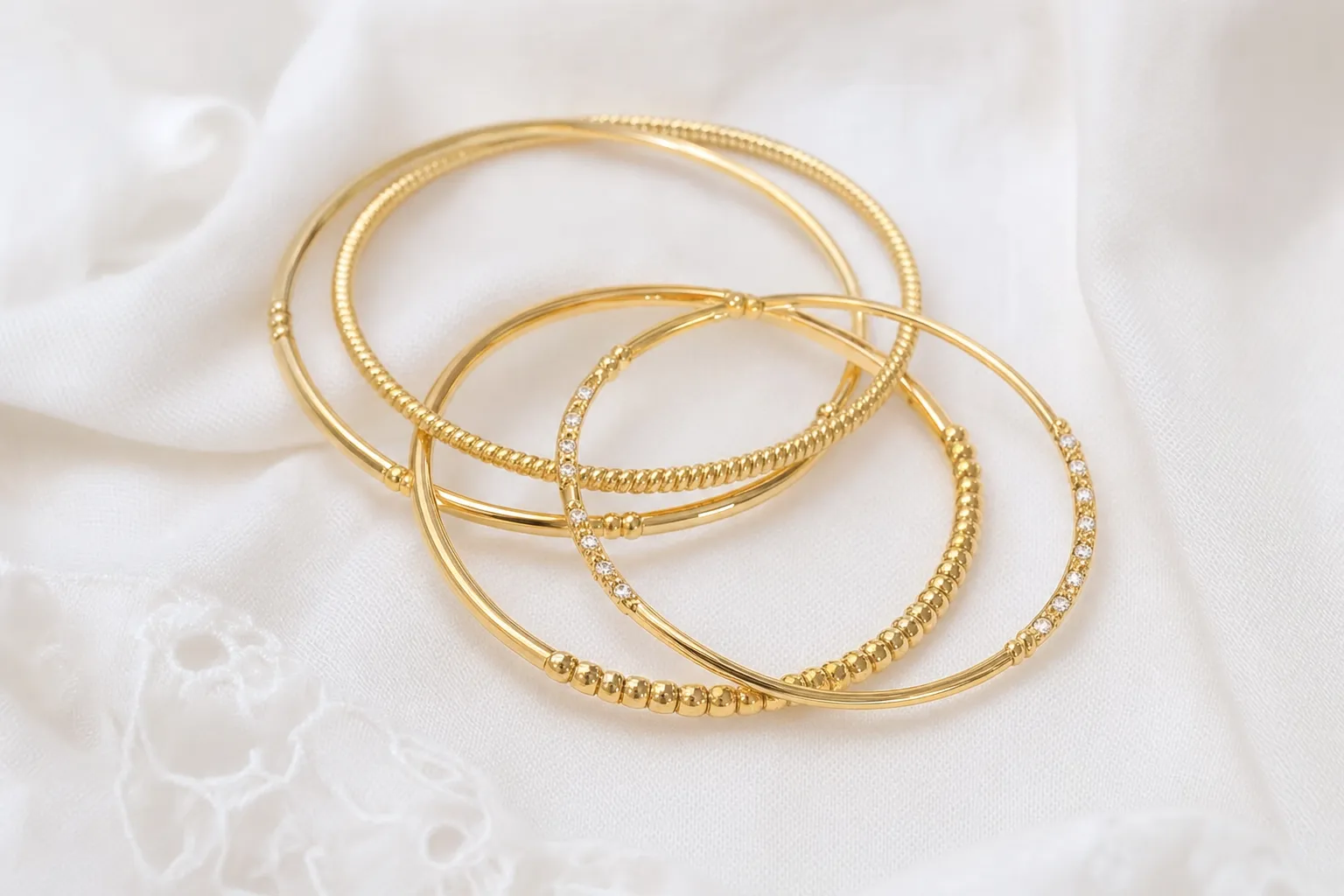
Bridal gold is the umbrella term for gold jewellery traditionally gifted at engagements and weddings, usually as bracelets, coins or full sets, common in families with Turkish, Kurdish, Arab, South Asian or Balkan roots. It is one of the oldest ways to pass wealth to the next generation visibly and wearably. What sets bridal gold apart from ordinary Swiss jewellery gold, how its value is calculated, and why we at émin still don't carry it, we explain here as plainly as possible.
What sets bridal gold apart from 18 carat gold
The key difference is fineness, the share of pure gold in the alloy. Bridal gold is traditionally made in 22 carat, which equals 22 of 24 parts pure gold, rounded to 91.6 percent, which is why it is usually stamped "916". Swiss jewellery, including ours, works predominantly with 18 carat gold, 75 percent fineness, occasionally with 14 carat, 58.5 percent. The difference is not a quality judgement but a different tradition with a different purpose: 22 carat holds more pure gold but is noticeably softer, since fewer alloying metals like copper or silver provide hardness. 18 carat is more resistant to scratches and everyday deformation thanks to its higher alloy share, at a somewhat lower pure gold content.
Why bridal gold is gifted at all
The tradition of gifting gold at engagements and weddings predates any modern national border and appears in similar form from Turkey across the Balkans to South Asia. Originally it served a very practical purpose: gold is tradeable everywhere in the world, doesn't lose its value through any single currency, and can quickly be turned into cash in an emergency. A young couple was given a financial cushion this way, worn visibly instead of hidden in a bank, and every guest who gave a bracelet or a coin publicly contributed to that cushion. This function as a wearable reserve has survived to this day, even though many families in Switzerland also keep conventional savings and bank accounts alongside it.
How the value of bridal gold is calculated
With bridal gold, almost the only thing that counts is weight in grams, multiplied by the current daily price for gold at that fineness, plus a comparatively small charge for workmanship. That differs sharply from rings with diamonds or coloured stones, where the stone often makes up most of the price and the metal is almost secondary. That is exactly why bridal gold is understood in many families as an investment too, something that can be melted down or sold again if needed, almost a wearable form of savings gold. The daily price fluctuates constantly, which is why bridal gold, unlike an individually designed ring, never has a fixed catalogue price, but is recalculated daily, roughly grams times price times fineness.
What that means for everyday durability
- 22 carat (916): very high gold content, therefore softer, more prone to scratches, dents and slight deformation with daily wear, especially with delicate bracelets.
- 18 carat (750): a good balance between gold content and everyday durability, the standard for most European rings, sturdy enough for daily wear.
- 14 carat (585): somewhat harder and more everyday-suited still, at a correspondingly lower pure gold content, common in Switzerland especially for heavily used jewellery.
For a piece worn every day on the finger and exposed to bumps, water and friction, like an engagement or wedding ring, that argues more for 18 or 14 carat. For a gift meant primarily as a store of value and worn rarely or only on special occasions, tradition tends to favour 22 carat. We explain which metal suits your personal use in general, independent of bridal gold, in our article on metals for jewellery.
Why émin doesn't carry bridal gold
22 carat bridal gold is its own craft, with its own alloying techniques, design traditions and market, one driven largely by the daily gold price rather than individual design. At émin we have deliberately specialised in individually designed engagement and wedding rings in 18 carat gold, with natural or lab-grown diamonds, and we would rather do this craft properly than offer a second one alongside it without the same care. What we're very happy to do instead: advise you honestly if you're looking for an alternative to classic bridal gold, such as a matching ring and bracelet set in 18 carat gold that you can actually wear every day, or a piece that echoes the symbolism of bridal gold but is built for everyday use. For couples looking for advice that knows and respects both traditions, our page for Muslim couples has more on our approach.
In the end, bridal gold is neither better nor worse than 18 carat jewellery, it's a different answer to a different question: visibly passing on wealth versus designing a piece for daily wear. Once you know which of the two questions matters more to you right now, the decision gets easier, and we're glad to help honestly with the second one.
Founder of émin, jeweller in Zurich
Have questions about your ring? Talk to us directly.
Book an Appointment