
Settings · honeycomb
Honeycomb setting: diamonds set in hexagonal cells
In a honeycomb setting, round diamonds sit in hexagonal cells, each stone held by six tiny beads. The pattern echoes a honeycomb, which is why it reads denser and more closed than classic pavé. Instead of individual sparkle points, you get one continuous surface that throws back light from every angle.
We use the honeycomb setting where maximum fire is called for: wide ring bands, pendants or combinations with Cuban links. At our atelier in Zurich District 4 or by video we show you samples and tell you honestly how this setting differs from classic pavé.
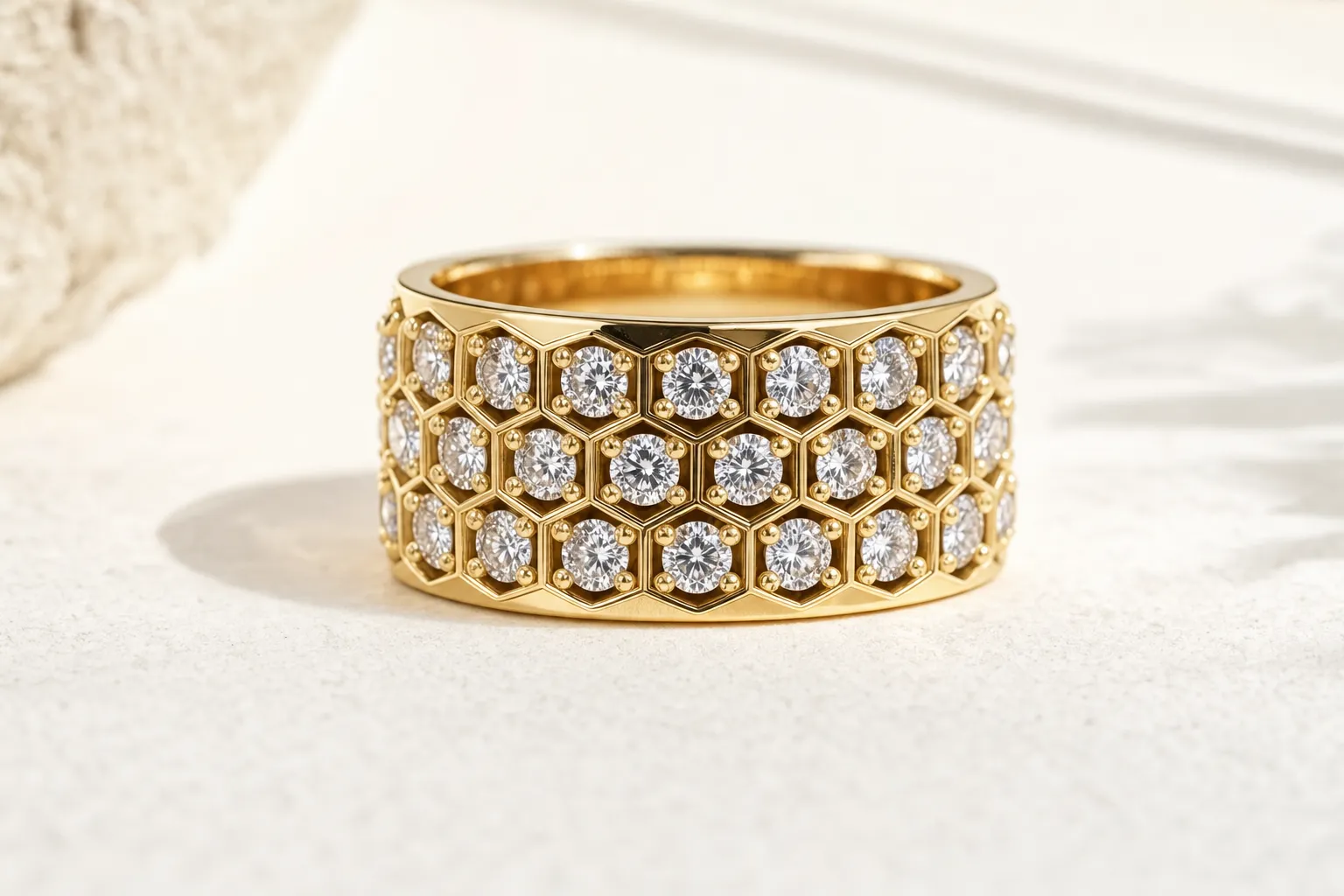
What makes the honeycomb setting special
Principle
Every diamond sits in a hexagonal cell held by six tiny beads instead of four or six classic prongs. That lets the stones sit closer together.
Effect
The hexagonal cells connect seamlessly, like a honeycomb. The result reads denser and more closed than classic pavé.
Where it fits
The setting suits wide bands, pendants and combinations with Cuban links, wherever a large surface should sparkle to the maximum.
How a honeycomb setting is built
In a classic pavé setting, each prong holds only one stone. In a honeycomb setting, neighbouring stones share the beads along their common edges, similar to an actual honeycomb structure. That saves space and pulls the stones visually closer together, without metal dominating between them.
This construction needs precise planning up front, so every cell fits exactly against its neighbour. We show you at the atelier what the finished pattern looks like in real light, and explain what to watch for when it comes to care.
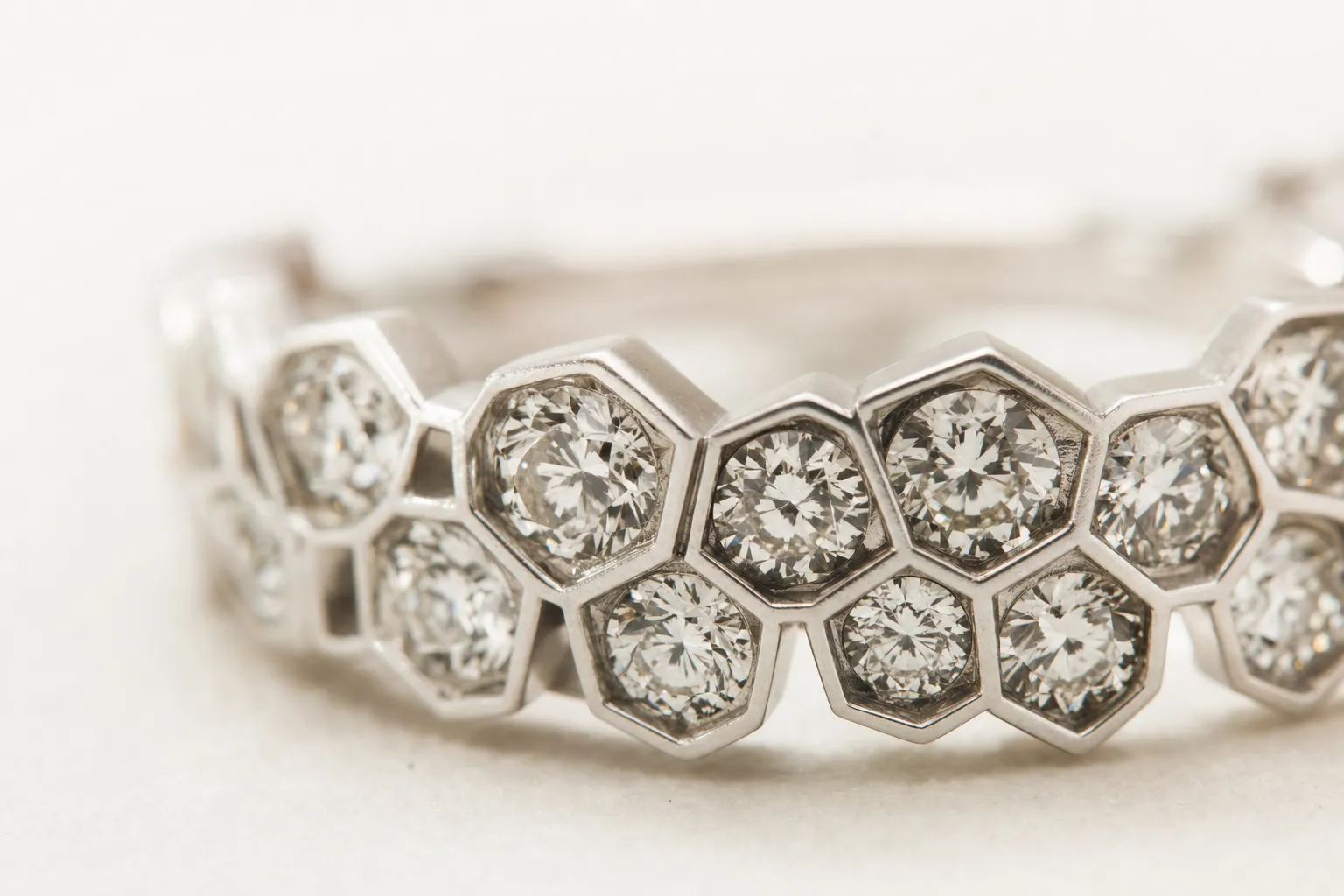
Honeycomb or pavé?
Both settings draw a lot of light from many small stones, just in different ways. Pavé looks lighter and is somewhat more affordable, because classic individual prongs need less upfront planning. Honeycomb looks denser and more closed, but is more elaborate to make.
Which setting suits your piece better depends on the surface, your budget and the look you're after. We show you both side by side before you decide.
Honeycomb compared to pavé
A first orientation, it does not replace the conversation at the atelier.
| Setting | Light | Safety | Upkeep | Price level |
|---|---|---|---|---|
| Honeycomb | high | good | low | high |
| Pavé / micro-pavé | high | medium | check regularly | medium |
Price level relative to a classic prong setting, we discuss the exact surcharge in person.
How your honeycomb-setting piece comes together
From the first conversation to handover, we guide you step by step.
Idea
You tell us which surface should sparkle, and we show you examples of the honeycomb setting at the atelier or by video.
3D design
We build your piece as a 3D model, so you see the honeycomb pattern before any work starts.
Stone selection
We choose round diamonds in matching sizes, so the cells fit evenly against each other.
Sign-off
Only once you're happy with the design, the stones and the price do we release the order.
Handover
At handover we show you the best way to care for the setting.
What a honeycomb setting costs
Guide prices so you can get your bearings in advance.
Price depends on the work involved. We calculate openly, no surprises.
We always discuss the exact surcharge with you in person, depending on surface and stone count.
Frequently asked questions
In a honeycomb setting, round diamonds sit in hexagonal cells, each stone held by six tiny beads. The pattern echoes a honeycomb, hence the name. Neighbouring stones share the holding beads along their common edges, which makes the surface look denser than classic pavé.
In pavé, each prong holds a single stone, and the stones sit close together but remain clearly recognisable as individual stones. In a honeycomb setting, neighbouring stones share the holding beads, making the surface look more closed and denser. Both techniques draw a lot of light from many small stones.
It looks especially good on wide ring bands, pendants and in combination with Cuban links, wherever a larger surface should sparkle to the maximum. For small, delicate rings the setting is less suited, there we'd recommend classic pavé instead.
The many tiny holding beads give it solid grip, about as sturdy as classic pavé. A hard knock can still loosen a bead, so we're happy to check the setting for free at every atelier visit.
The surcharge depends on the surface and the number of stones, and sits above a classic prong setting because the planning and making take more time. We calculate the exact amount with you in person.
Yes, that's possible, for example a band in honeycomb setting with a classically set centre stone. We show you at the atelier how the two techniques can be combined and what that means for price and care.
Quick enquiry
Curious about the honeycomb setting?
Tell us which piece you're interested in, or send us a photo as a reference. We'll tell you honestly whether a honeycomb setting fits your plan.