
2026-09-03 · 5 min.
What is fluorescence in diamonds?
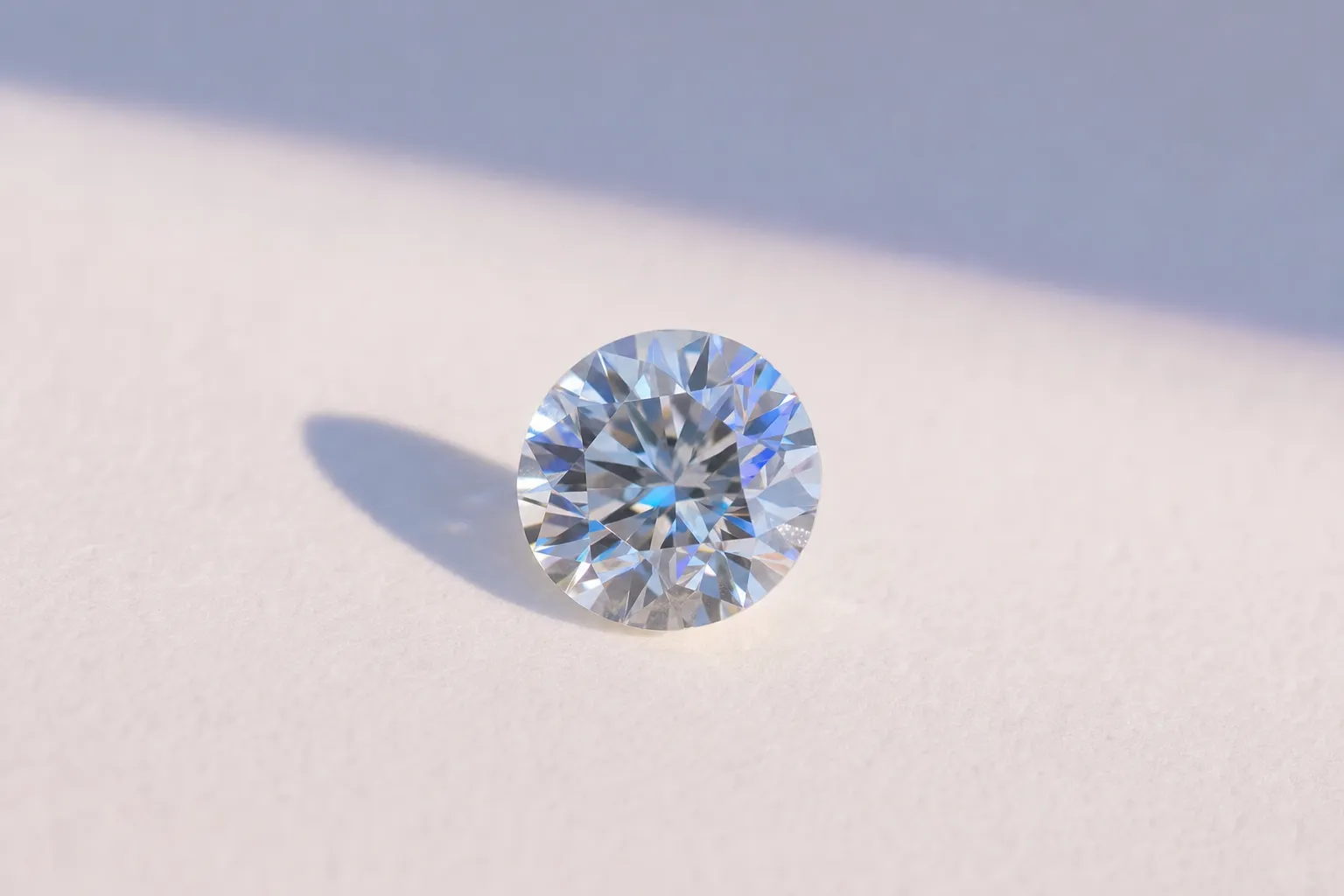
Fluorescence describes how a diamond glows under UV light, usually blue, more rarely yellow or white. It appears on every certificate as its own line, but it has nothing to do with the actual quality of a stone, its cut, colour or clarity. Here is what fluorescence actually is, how it happens, and when it plays any role at all.
What happens inside the stone when UV light hits it
Some diamonds contain tiny traces of other elements, often boron, or fine structural quirks in the crystal lattice that formed while the stone grew. When invisible UV light hits these spots, they briefly absorb the energy and immediately release it again as visible light, which we perceive as a faint glow. Roughly a quarter to a third of all diamonds show some degree of this reaction, most commonly blue, more rarely yellow, white, or occasionally other tones.
The scale on the certificate
- None: the stone shows no detectable reaction under UV light.
- Faint: a barely noticeable reaction, only visible under strong UV light.
- Medium: a clear but muted reaction under UV light.
- Strong: a clearly visible reaction under UV light.
- Very Strong: an intense reaction, noticeable immediately even briefly under UV light.
When fluorescence is even visible at all
In everyday life, under normal indoor light or most lamps, fluorescence is practically invisible, because that kind of light barely contains any UV. It becomes visible mainly under an actual UV lamp, the kind you would recognise from a club or a passport check, or, in cases of very strong fluorescence, occasionally in direct, bright outdoor daylight, which does carry a small UV component. For the everyday wear of an engagement ring, this makes no practical difference in the vast majority of cases.
The old myth: fluorescence makes a stone worse
For decades, a rumour persisted that fluorescence made diamonds look milky or oily. Larger studies, including a well-known one from GIA, show that for the large majority of stones, fluorescence has no visible effect on appearance at all, neither positive nor negative. Only in a very small number of stones, usually with very strong fluorescence combined with certain clarity characteristics, can a slight hazy shimmer appear, and even that is almost only detectable under strong UV light, rarely in everyday conditions. In stones with a slightly warmer colour, roughly in the H to J range, blue fluorescence can even offset the yellowish undertone a little, making the stone look visually whiter in daylight.
Fluorescence as a clue: lab-grown or natural
Fluorescence also becomes interesting when it comes to whether a diamond formed naturally or grew in a lab, more on that in our article on CVD and HPHT. Natural diamonds usually show fluorescence spread evenly across the whole stone, classically in a calm blue. In lab-grown diamonds, especially those grown by CVD, the pattern can be more irregular, with a net-like or striped growth pattern, sometimes in tones other than blue. HPHT-grown stones, on the other hand, often show no fluorescence at all, or only a very weak one. For professionals this is one clue among several used to determine a stone's origin and growth method, never the only proof. In the end, what is always reliable is the certificate itself, which states exactly whether and how a stone formed.
Why honest advice here can save you money
Because the myth persists so stubbornly, diamonds with medium or strong fluorescence are sometimes priced lower on the market than visually near-identical stones without fluorescence, even though the visible difference is essentially zero for most wearers. We show you how fluorescence reads on a certificate together with cut, colour, clarity and carat on our IGI-certified diamonds page. We explain the other three C, cut, colour and clarity, from the ground up in our 4C article.
If you are unsure whether a particular fluorescence grade suits the stone you have in mind, simply bring the certificate along. We will look at it together, in daylight and, if you like, briefly under UV light too, so you can see for yourself what the entry on the paper actually means.
Founder of émin, jeweller in Zurich
Have questions about your ring? Talk to us directly.
Book an Appointment