
2026-09-03 · 4 min.
Honeycomb setting: how the honeycomb pattern works
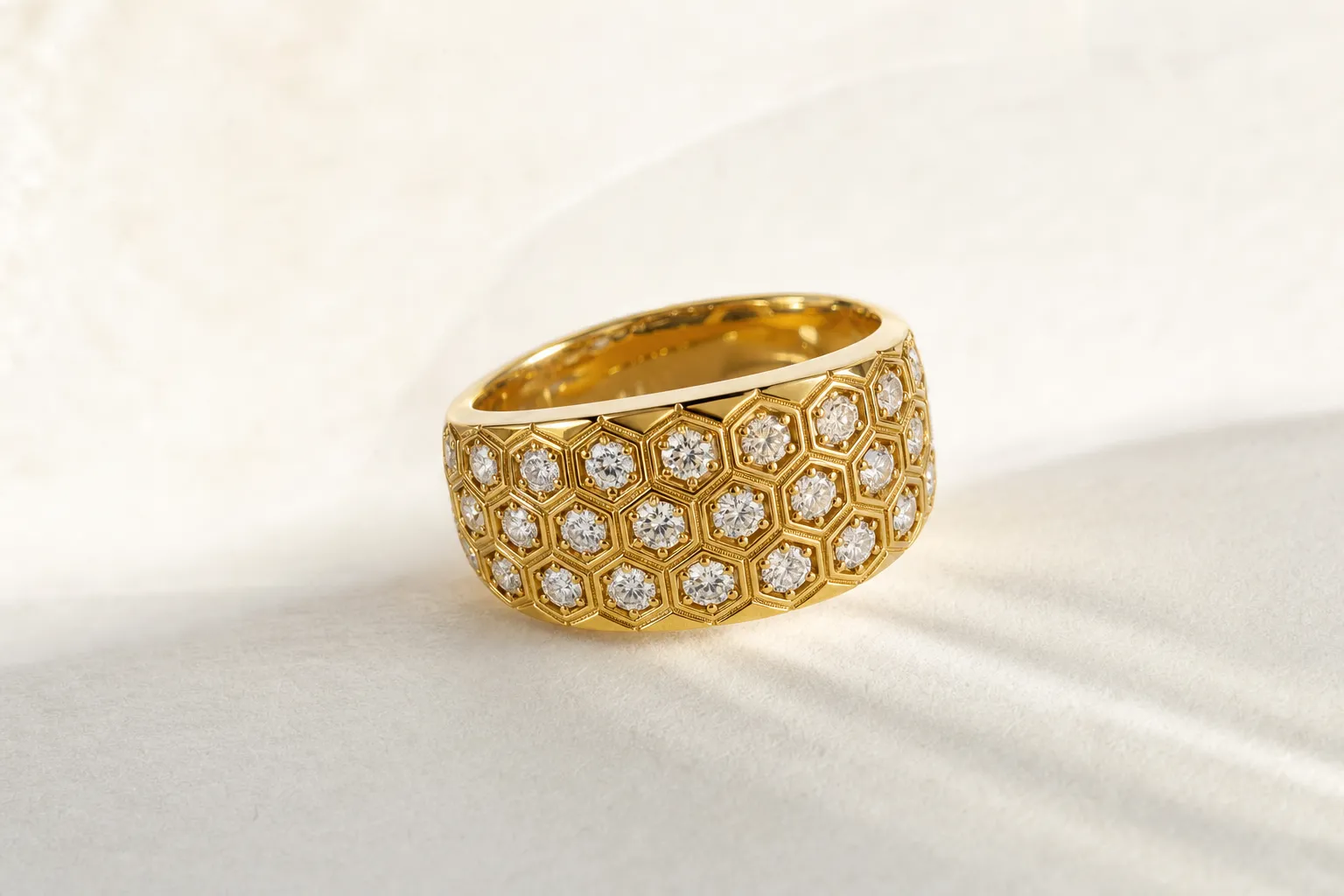
Honeycomb setting is one of the newer setting techniques that has become popular in recent years, especially on wider bands, pendants and iced-out jewellery, and the name is fitting: the finished pattern really does resemble a honeycomb. Here we explain how this setting technically works, how it differs from the better-known pavé setting, and which pieces it suits.
How the honeycomb setting is built
In a classic pavé setting, small diamonds sit close together, each held by several fine prongs that are partly shared with neighbouring stones. Honeycomb setting takes the technique a step further: the round stones sit in hexagonal cells, similar to a beehive, and each individual stone is held by six tiny metal beads positioned exactly at the corners of the hexagon. Because the cells connect seamlessly, the whole surface looks denser and more evenly covered than classic pavé, with less visible metal between the stones.
- Structure: hexagonal cells, each stone held by six tiny beads.
- Effect: denser and more even than classic pavé, a continuous sparkle pattern instead of individual points.
- Light: excellent, since hardly any metal stays visible between the stones.
- Suited for: wide bands, pendants, combinations with cuban links and other iced-out jewellery.
Why honeycomb looks denser than pavé
The difference lies in the geometry. Hexagons can be lined up with no gaps, the way bees do it in nature, while round cells in a classic pavé layout always leave small gaps. This gapless arrangement is why a honeycomb setting shows more stones and less visible metal than a comparable pavé surface of the same size. To the eye that means a more unified, homogeneous sparkle, almost like a continuous surface of light instead of individual points.
What matters in the craftsmanship
For a honeycomb setting to look clean, all the stones need to be practically identical in size and cut quality, calibrated stones, otherwise every small deviation stands out immediately in the dense pattern. That makes this setting more demanding in terms of stone selection than a classic setting with a single centre stone, where an individual character of the stone is even desirable. We explain the basics of diamond quality without the jargon, colour, clarity, cut, in our basics article on the 4C's.
Care and security
A honeycomb setting holds well, because each stone is held at six points instead of just three or four as with some other settings. But because the surface is densely covered, dirt and skin oils gather between the stones more easily over time, which dulls the shine. Regular, gentle cleaning and a professional check once a year keep the surface sparkling.
Where the name comes from and where honeycomb is used today
The name is not a marketing invention, it describes the geometry literally: hexagons are nature's most efficient shape for filling a surface without gaps, which is exactly what bees use when building their combs, and exactly what this setting technique uses for diamonds. In jewellery, honeycomb setting has become popular mainly in recent years, first on wider bands and cuban chains in iced-out pieces, and more recently on pendants, earrings and individual bands. The reason is simple: hardly any other technique shows this much sparkle in such a small space.
Cost and effort compared
Because every single stone needs to be precisely calibrated and set individually into its cell, a honeycomb setting takes noticeably more work time than a classic setting with a single centre stone. That shows in the price, a piece with honeycomb setting costs more than one with classic pavé at a comparable surface size. In return you get a surface that clearly stands apart from mass-produced pieces, because the precision is visible to the naked eye. We discuss with you upfront on every honeycomb project how many stones of which size are realistic, so you know what to expect before the work begins.
Honeycomb compared to other setting techniques
Honeycomb is one of several techniques used to set multiple stones densely and effectively, alongside classic pavé or mosaic setting, where larger, calibrated stones sit next to each other with no visible metal at all. For a full overview of all setting styles, with pros and cons compared, see our page on settings explained.
If the dense, honeycomb-shaped look appeals to you, we are happy to show you real examples at an appointment in our atelier in Zurich district 4 or by video, and discuss which stone size and band width work best for your piece.

Founder of émin, jeweller in Zurich
Have questions about your ring? Talk to us directly.
Book an AppointmentQuick enquiry
Let's talk about your ring.
A free, no-obligation consultation at the atelier in Zurich or by video. Honest answers, no sales show.