
2026-09-03 · 4 min.
Mosaic and invisible setting: stones without visible metal
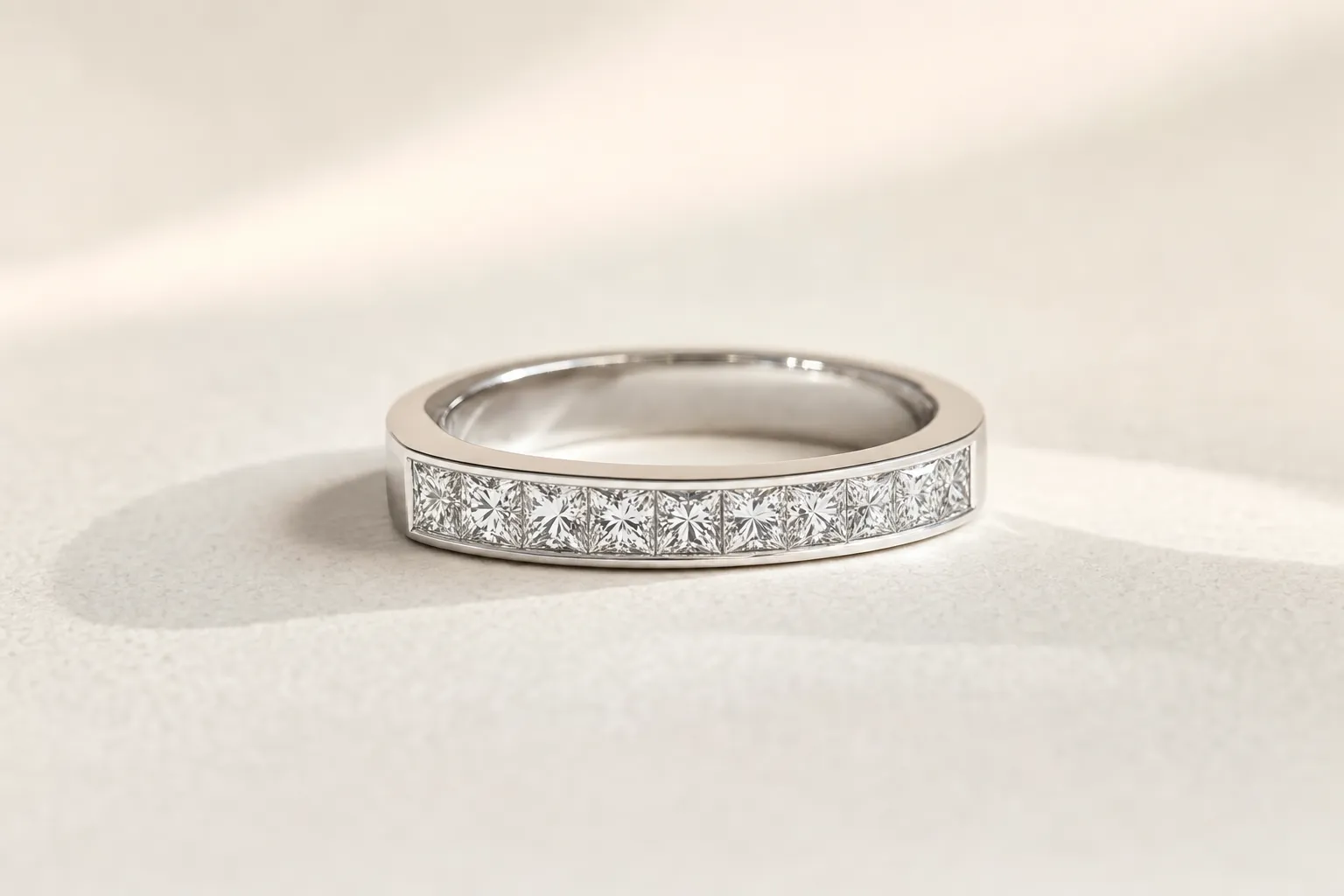
If you have ever seen a piece of jewellery where the stones look like one closed, sparkling surface, without the fine metal struts you usually expect between diamonds, you were probably looking at a mosaic or invisible setting. This setting technique is among the most demanding of all, and that is exactly what makes it so special. Here we explain how it works and what matters most about it.
How the technique works
In a classic setting, a prong or a strut holds each stone from the outside. In a mosaic or invisible setting, that visible support disappears entirely. Instead, the stones are cut with fine grooves along their sides and slid into a grid of thin metal rails that sit underneath and cannot be seen from above. This creates the impression that the stones sit directly against each other, with no metal at all between them, almost like one closed, sparkling surface cast as a single piece.
- Structure: stones with side grooves, held by a hidden rail grid instead of visible prongs.
- Effect: a closed, even surface, with practically no visible metal.
- Requirement: precisely calibrated stones, identical size and cut accurate to a tenth of a millimetre.
- Suited for: bands, pendants, small surfaces where maximum impact in minimal space matters.
Why this setting is so demanding
For the stones to look truly seamless, they need to be cut and calibrated to within fractions of a millimetre, since even the smallest deviation in size or shape would stand out immediately in such a dense pattern. This precision work takes correspondingly more time and workshop experience, which makes this setting more elaborate than a classic setting with a single stone. We explain how different diamond qualities actually come about, colour, clarity, cut, without the jargon in our basics article on the 4C's.
Security: the honest point
Because no visible metal strut protects the individual stone from the outside in a mosaic or invisible setting, this setting is more sensitive to impact than a classic prong setting. A hard knock can cause a stone to come loose from the rail system, which is why this technique is used less often on heavily used bands and more often on surfaces with less daily contact, such as pendants or as an accent rather than a load-bearing structure. We tell you this honestly because we want you to know what you are getting into, not just how beautiful the result looks.
Caring for a mosaic setting
Because dirt and skin oils build up easily between the tightly packed stones, we recommend careful but gentle cleaning and a professional check at least once a year, verifying that all stones still sit firmly in the rail system. If the piece is worn a lot, that check is worth doing more often.
Where the name comes from
"Mosaic setting" describes the result, not the technique: a surface made of many small, precisely fitted pieces, like a mosaic image made of stone instead of glass or ceramic. "Invisible setting" describes the same thing from the other direction, naming what is missing, namely visible metal. Both terms are used almost interchangeably in the jewellery world, even though some houses make fine distinctions in the exact execution. For you as the wearer, what matters most is the result: a closed, sparkling surface that looks at first glance like a single large piece, even though it is made up of many individual stones.
Cost and effort compared
The precision work behind a mosaic setting takes noticeably more time than a classic setting with a single centre stone, and that shows in the price. Beyond the setting work itself, there is also sourcing the calibrated stones, which need to match each other exactly, and that itself takes time depending on the surface and stone size you want. We discuss with you in the atelier upfront on every mosaic project which surface and stone size are realistic, so you know what to expect before the work begins. For smaller accents, such as on a band or a pendant, the extra effort is usually manageable, on larger surfaces it is noticeably more.
Mosaic setting compared to other techniques
Mosaic and invisible setting are the densest way to set multiple stones without visible metal, alongside honeycomb setting, where round stones sit in hexagonal cells, or classic pavé setting with visible fine prongs. For a full overview of all setting styles, with strengths and limits compared, see our page on settings explained.
If the closed, sparkling surface of a mosaic setting appeals to you, we are happy to discuss at an appointment in our atelier in Zurich district 4 or by video which piece and which surface this technique really suits, and where a more robust setting is the better choice.

Founder of émin, jeweller in Zurich
Have questions about your ring? Talk to us directly.
Book an AppointmentQuick enquiry
Let's talk about your ring.
A free, no-obligation consultation at the atelier in Zurich or by video. Honest answers, no sales show.